
A Promise No One Checks
A written investment policy is a promise you make to yourself. Who checks that you keep it?

Picture the afternoon an investment policy gets written. Maybe an adviser walks you through it. Maybe it’s you, a spreadsheet and a quiet Sunday. You start with what the money is for: a cushion so that a bad year never reaches the family, a portfolio that keeps your standard of living, and a smaller part that is allowed to swing for something bigger. Then come the rules. How much goes where. What happens after a fall of fifteen percent. What you will never buy.
You sign it, or save it as final_v3, and it feels good. That feeling is earned. Most investors never get this far.
Then the document goes into a drawer, and nobody asks the obvious question: who checks that you keep it?
Last week was about the last mile between knowing your rules and following them. This week is about the document meant to cover it, and why, on its own, it doesn’t.
What your goals have to do with it
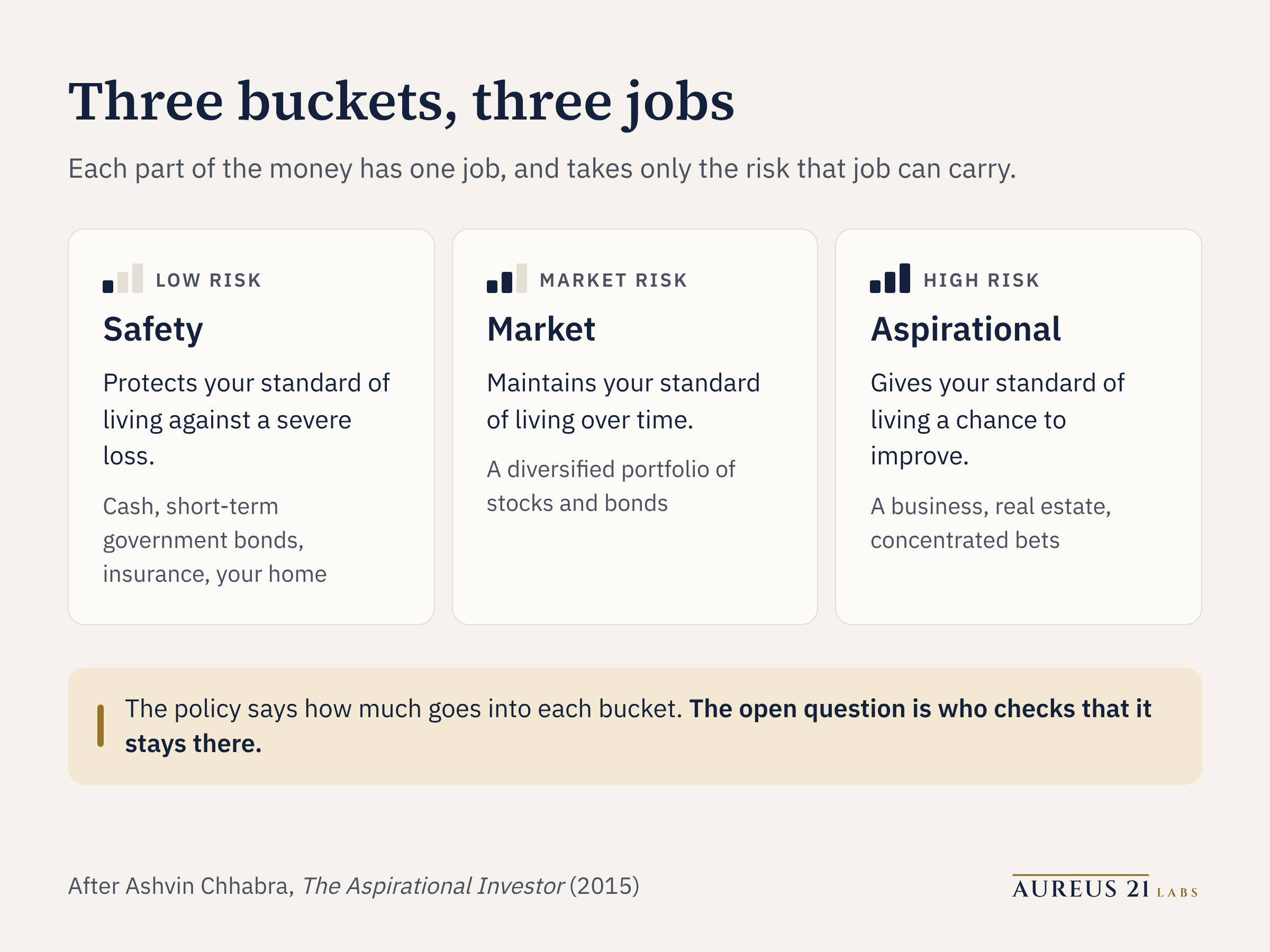
People don’t invest for returns. They invest for what returns can buy: security, a way of life, a shot at something more. Ashvin Chhabra, a physicist by training and a former chief investment officer of Merrill Lynch Wealth Management, built a framework around that idea in his book The Aspirational Investor. The money is split into three buckets with three jobs. A safety bucket protects your standard of living against a severe loss. A market bucket maintains it over time. An aspirational bucket gives it a chance to improve. Each bucket takes the risk its job can carry, and no more.
I like this approach for a reason that has little to do with asset allocation: goals make promises stronger. In a field experiment in rural India, Dilip Soman and Amar Cheema had part of construction workers’ weekly wages sealed in envelopes as savings. When the savings were split into two envelopes instead of one, households saved far more. When those envelopes also carried a photo of the workers’ children, they saved more again: over fourteen weeks, nearly twice as much as with one plain envelope. The workers were free to open the envelopes whenever they needed the money. Separate pots, and a reminder of who the money was for, made that harder.
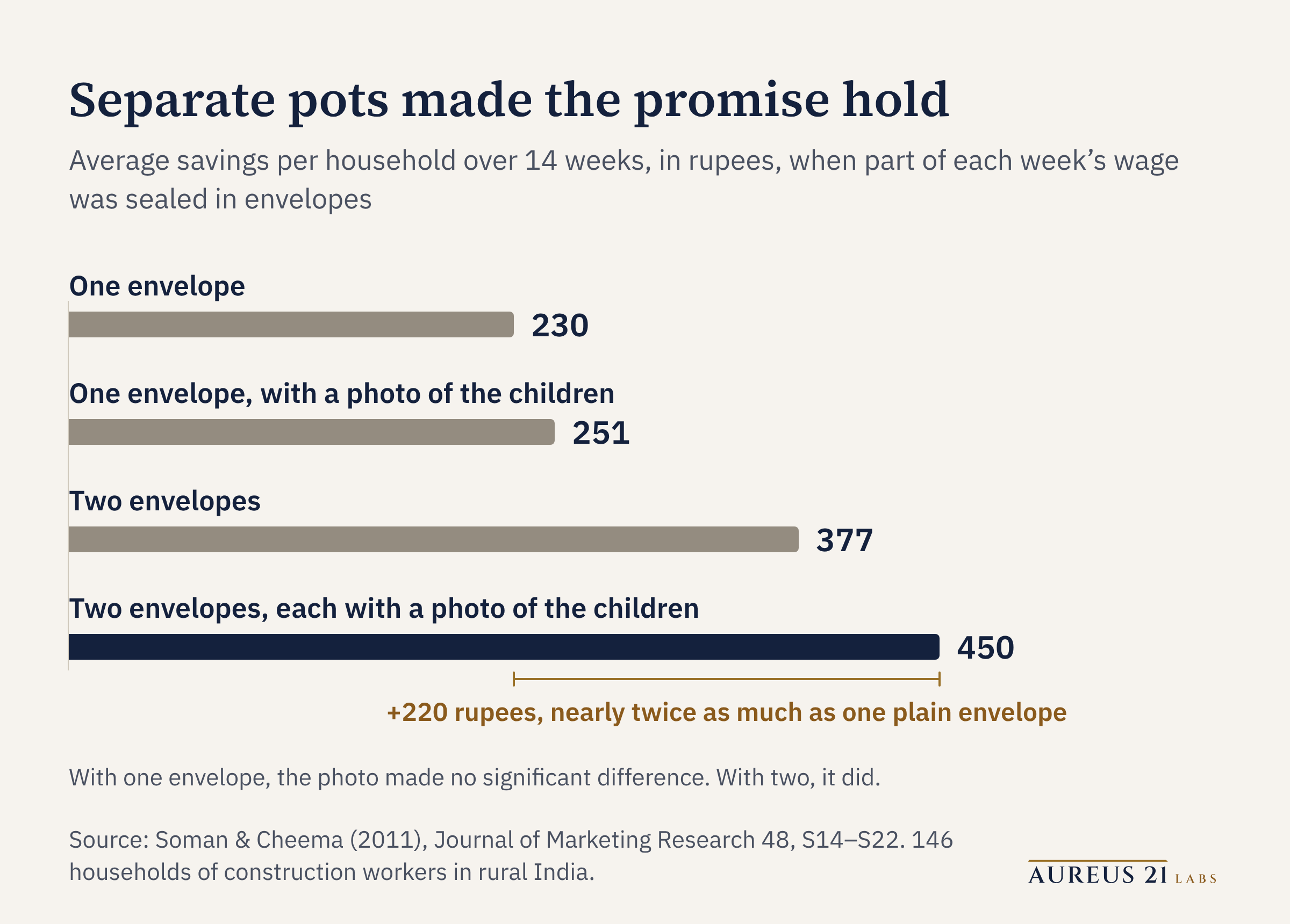
Chhabra’s buckets work the same way. That is the strength of goals-based investing: it borrows the strongest motive people have. It’s also why a broken rule hurts more here than a tracking error ever could. When a portfolio drifts away from its policy, it drifts away from the people and plans the policy was written for.
How the buckets leak
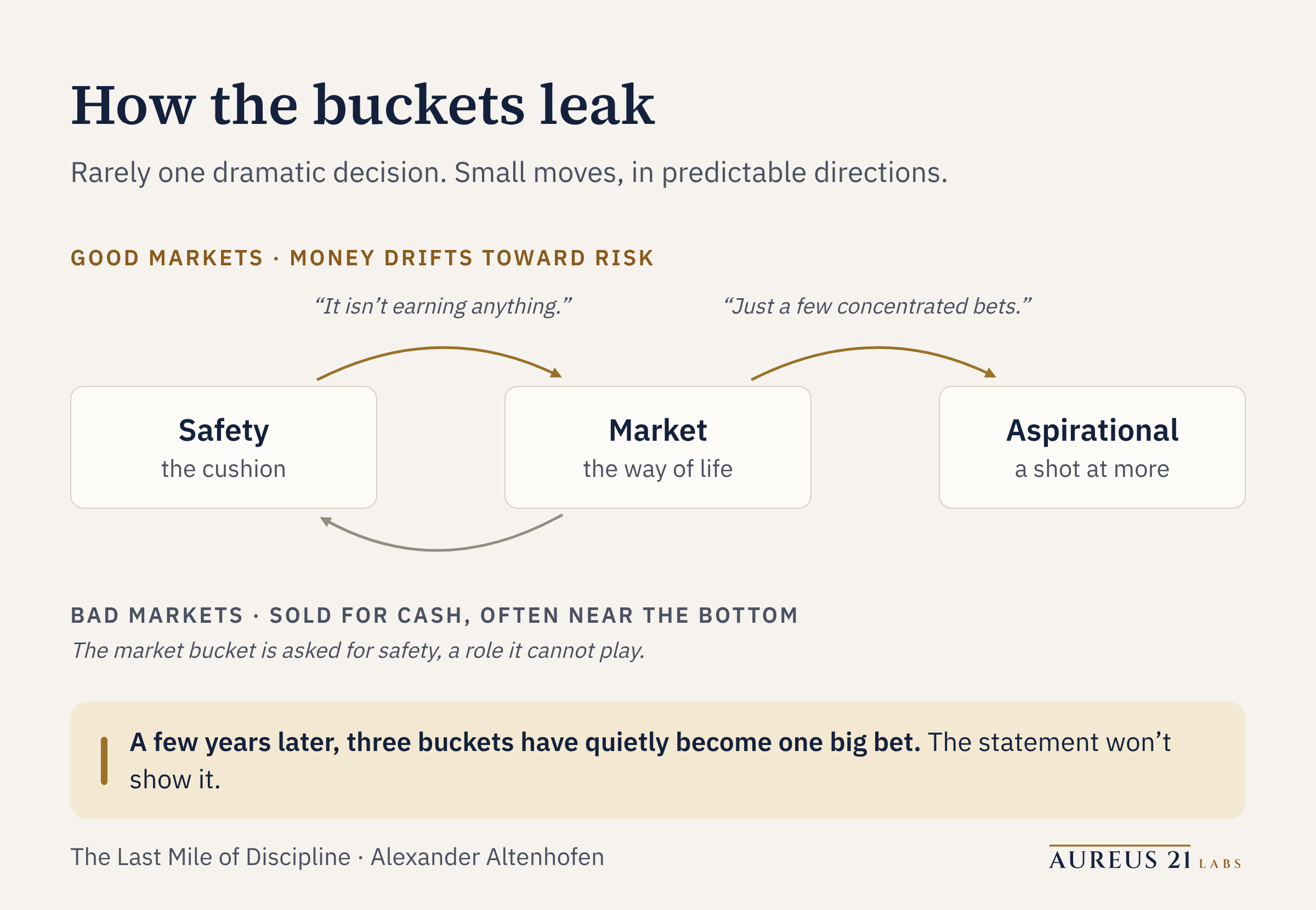
Buckets rarely break in one dramatic decision. They leak, in predictable directions.
In good markets, money drifts toward risk. The safety bucket “isn’t earning anything,” so part of it goes into the market. The market bucket picks up a few concentrated bets that belong in the aspirational one. Each move is small and sounds sensible.
In bad markets, it flees the other way. Investors sell from the market bucket to raise cash, using it as a source of safety, a role that, in Chhabra’s words, it “cannot and should not play.” And they tend to sell close to the bottom.
A few years of this, and a three-bucket plan has quietly become one big bet. The statement won’t tell you. It reports totals and returns, not whether each bucket still does the job it was given.
The knot in your own hands
When Odysseus sailed past the Sirens, he didn’t rely on willpower. He had his crew tie him to the mast and told them that if he begged to be released, they should tie him tighter. Their own ears were plugged with wax, so the song couldn’t change their minds.
Look at the division of labor. Odysseus wrote the rule in a calm moment. Someone else enforced it in the hot one, and that someone couldn’t be talked out of it.
Most investment policies are Odysseus without the crew. The rope is there, but you’re holding the knot yourself. It holds until the music starts.
The research on goals says the same thing in less poetic terms. A meta-analysis of 138 studies with almost 20,000 participants, published in Psychological Bulletin in 2016, found that monitoring your progress makes you more likely to reach a goal. The effect was larger when progress was physically recorded, and when it was reported to others or made public. A promise holds best when progress is written down and seen by someone other than the person who made it.
What institutions know
Institutions worked this out long ago. They call it governance, which sounds like bureaucracy but is really a set of answers to one question: who checks?
In a well-run pension fund or asset manager, the people who make investment decisions are not the people who check them. Orders are tested against the client’s guidelines before they are released, and anything that would breach them goes to someone with the authority to say no. Changes to the policy go through a committee and are minuted. Exceptions are possible, but they are written down, with a name and a reason.
None of this assumes that portfolio managers are weak. It assumes that they are human.
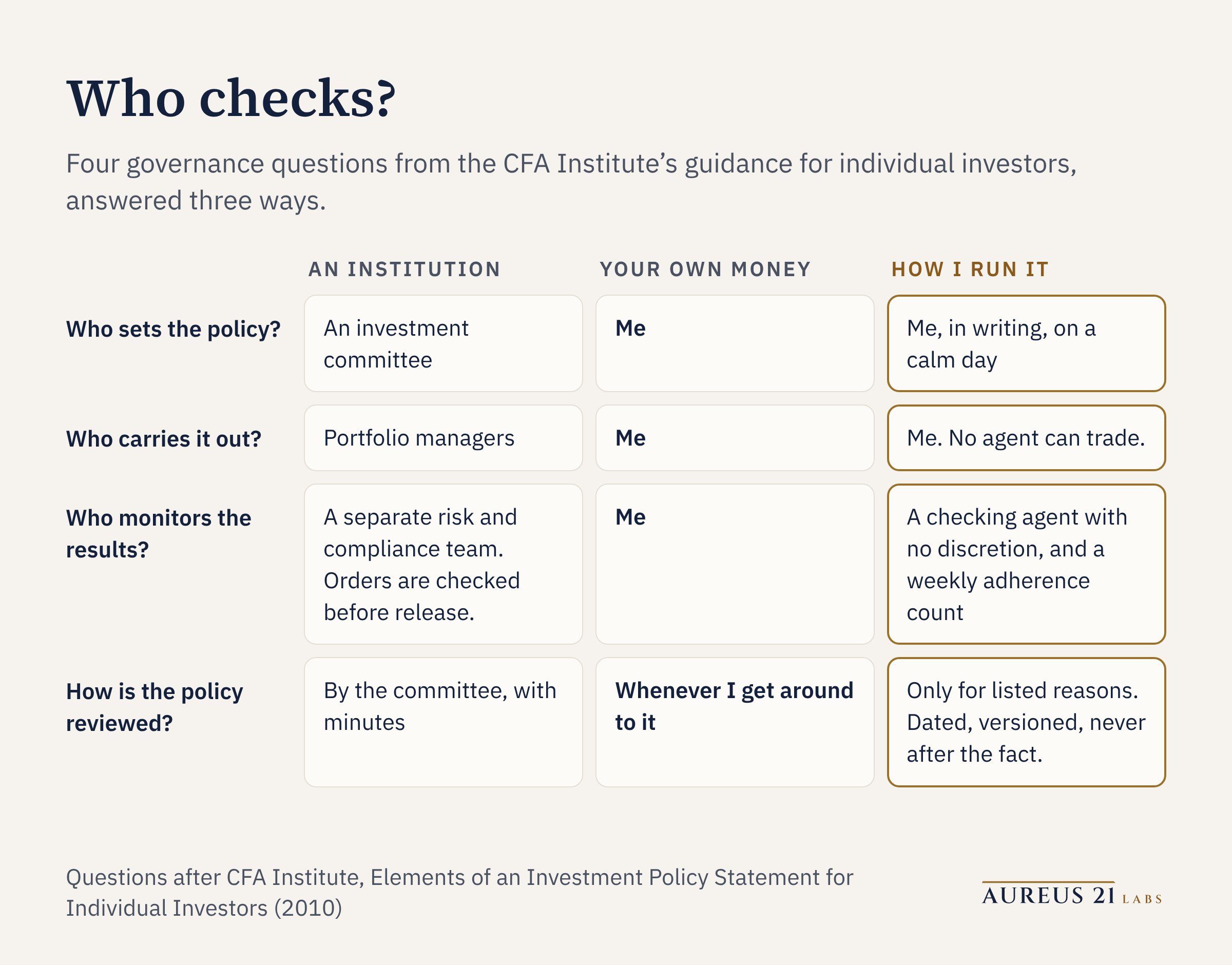
Private investors have the same document, but rarely the machinery around it. The CFA Institute’s guidance on investment policies for individual investors, published in 2010, lists four elements. The second is Governance: who sets the policy, who carries it out, who monitors the results, and how the policy is reviewed. If you manage your own money, the honest answers are: me, me, me, and whenever I get around to it.
That isn’t a character flaw. It’s a missing structure. Institutional rigor is usually discussed as something for very large fortunes. The governance part of it scales down remarkably well.
How I run it
The objectives I wrote for my own portfolio put it in two sentences: “Success isn’t beating the market. Success is keeping my rules, year after year, regime after regime.” Everything else in my setup exists to make that second sentence checkable.
To get there, I borrowed the institutional answers and scaled them down to the size of a family:
- The one who decides isn’t the one who checks. Every proposal is meant to be checked against the current version of the rules before anyone acts on it. The checking agent has no discretion: its own mandate forbids it to interpret a rule or grant an exception. Like the crew, it can’t be talked into anything. It can stop a purchase, but never a sale, because cutting risk is always allowed.
- Overrides exist, in writing. I can overrule a verdict, but only in the record itself, with a reason and a date, and only for one item on one day.
- Evidence beats memory. Each week, the check counts how many of the actions the rules required were carried out within their deadline, and how long the slowest one took. For my broker account, it only accepts the broker’s execution records. My own note that something is done doesn’t count.
- No rewrites after the fact. My policy lists the few reasons a rule may change at all. Every change is dated, versioned and justified in writing, and the policy says in plain words that a rule may never be changed retroactively to justify a decision already made.
One recent week: fourteen actions due at my broker, all fourteen carried out within their deadline, the slowest of them one trading day after its signal. The return that week was the market’s doing. The adherence was mine.
Three questions for your policy
Find your investment policy, if you have one, and ask it three questions:
- When did someone other than you last check a decision against it?
- Does it still say what each part of the money is for, and does the portfolio still match?
- If a rule changed in the last year, can you show when, and why?
If the answer to the first is “never,” you don’t have a policy. You have a promise no one checks.
Next week: what happens when the rulebook is written so that a machine can read it, and every order is checked against it before it goes out.
Alexander Altenhofen is the founder of Aureus 21 Labs and SVP Product & Tech at a large media company. He privately runs his family’s portfolios on a written rulebook with a team of AI agents. This post describes his own approach and is not investment advice.