
Agents Propose, Code Checks
An AI agent can read a capital call in seconds. Whether that number goes into the books is a different question.

A PDF arrives on a Thursday evening: a capital call from a private equity fund. Nine pages, most of them legal boilerplate. On page two is a small table with five numbers that look alike: your commitment, what was called before, this call, the total called after it, and what remains open. One of them has to go into the books, against the right fund, and the money has to be in the account by the due date.
An AI agent can do that reading in seconds. It finds the fund, the date and the amount, and it never gets bored on page two.
So the question isn’t whether an agent can read the notice. It’s whether the agent should also be the one who books it.
The last three posts were about the last mile of discipline: why knowing your rules isn’t the same as following them, and how rules written as code close the gap. This is the first of three posts about rules at work: what changes when AI agents join the team, and who does what.
Good at reading, not at keeping books
Agents are very good at a certain kind of work. They read a long document and find the three numbers that matter. They gather facts from several places. They explain them in plain language. In my family office, they do most of the reading and most of the writing.
Books ask for something else. A capable model takes the right line from that table almost every time. Books need every time. And when the model is wrong, it is wrong with a perfectly reasonable explanation attached: the total called so far, booked as this call. Nothing about the result looks broken.
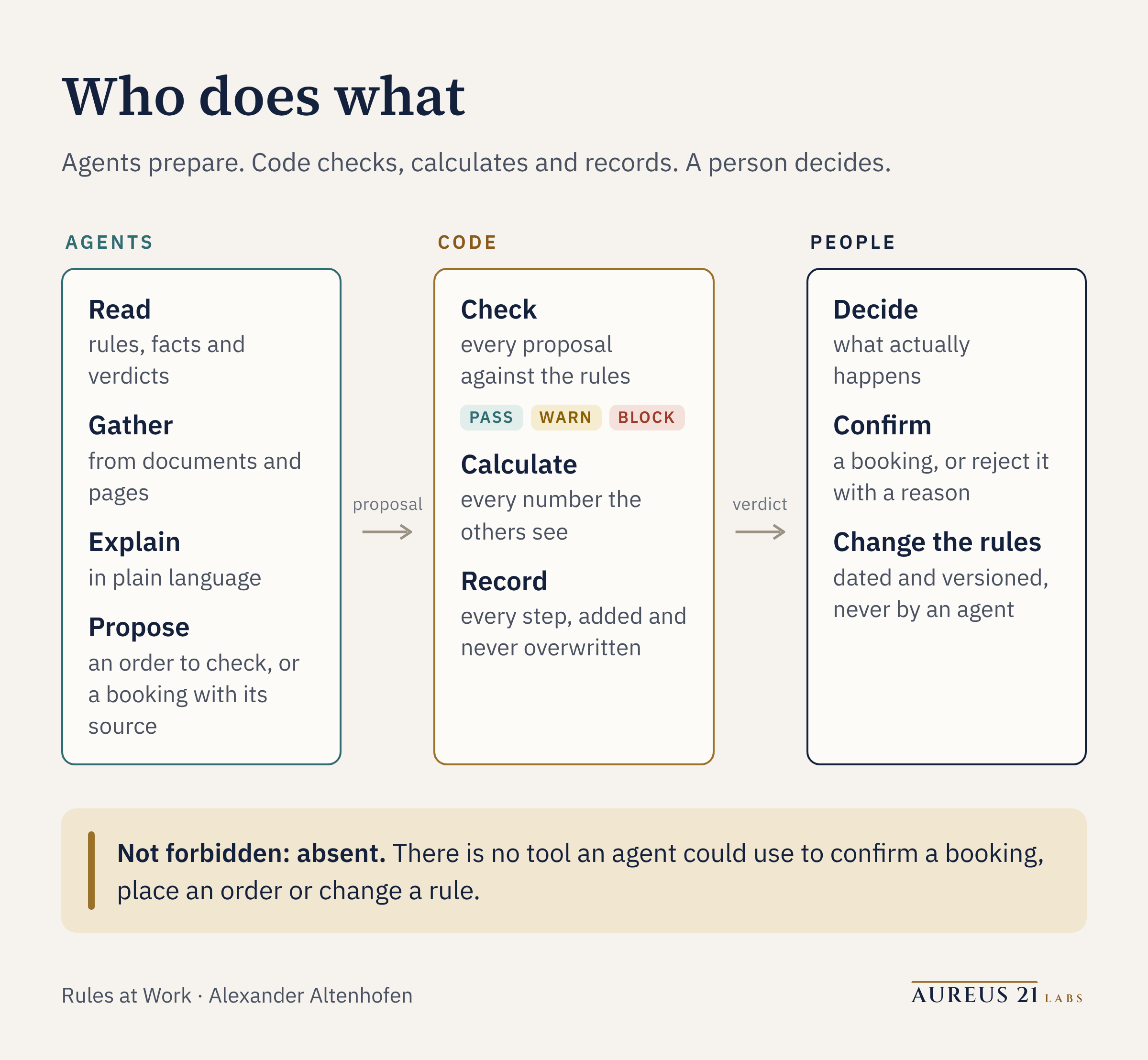
That isn’t a flaw you fix with a better prompt. It’s what probabilistic systems do, and it’s why, in my setup, agents propose, code checks and a person confirms.
The oldest control in finance
Banks learned this long before there were agents, and one of the most expensive lessons came from Singapore.
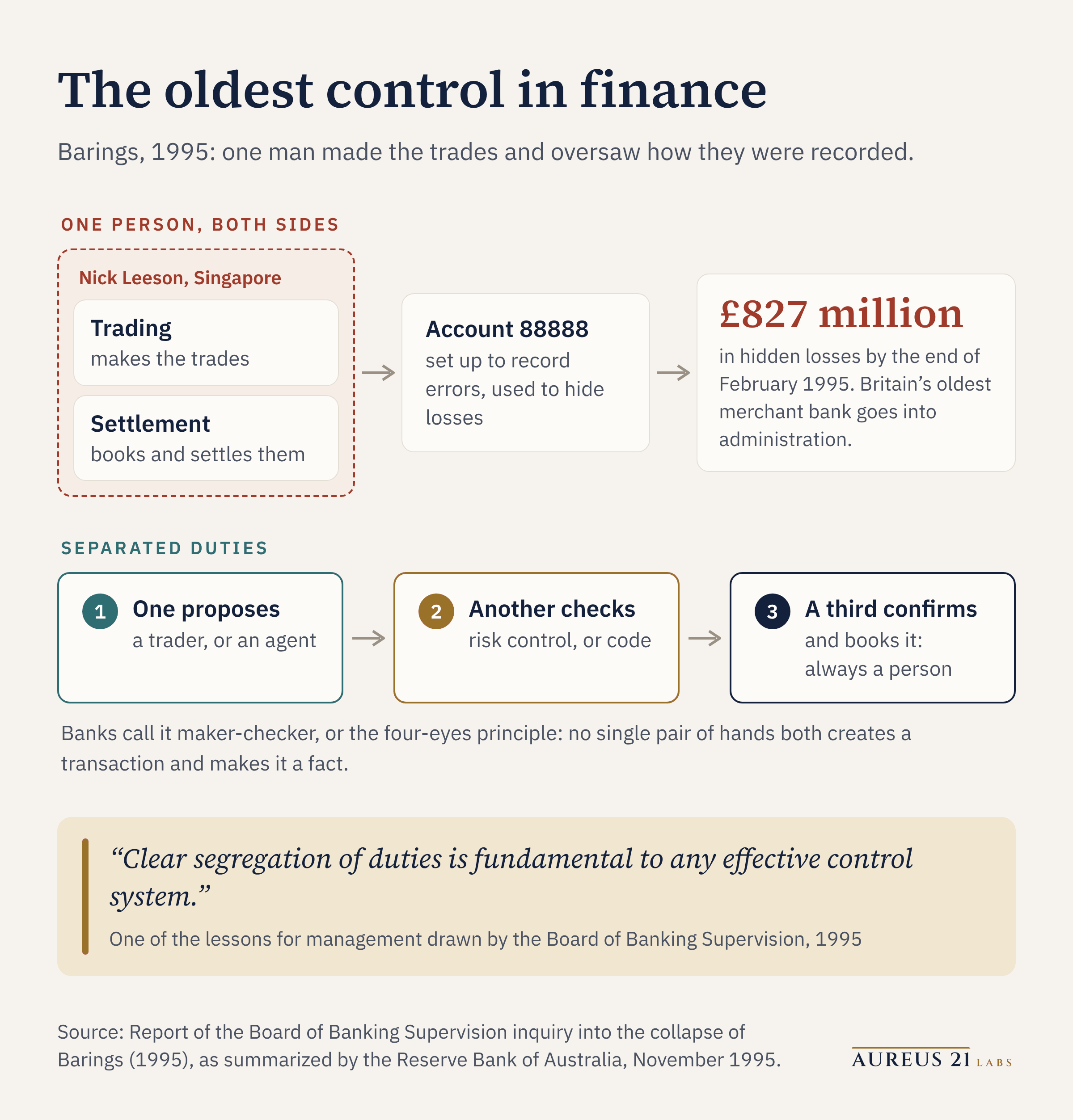
In February 1995, Barings, Britain’s oldest merchant bank, collapsed. Nick Leeson ran its futures business in Singapore, and as general manager he controlled both sides of it, as the inquiry by the Bank of England’s Board of Banking Supervision found: he made the trades, and he oversaw how they were recorded and settled. His losses went into an account numbered 88888, originally set up to record errors. By the end of February, they had reached £827 million, and the bank went into administration.
The board drew several lessons for management. One of them fits on a single line: “clear segregation of duties is fundamental to any effective control system.”
Banks call it maker-checker, or the four-eyes principle. The person who creates a transaction is never the person who approves it and makes it a fact. It isn’t a verdict on anyone’s character. It’s a design that makes an error visible before it becomes a fact.
An agent is not a rogue trader. It has nothing to hide and no bonus to protect. But the control was never really about motives. It’s about errors that look plausible, and agents produce exactly those. So they get the treatment of a new hire on day one: they can prepare anything, and book nothing.
What an agent can do, and what it can’t
In my setup, agents can connect through the Model Context Protocol, an open standard for giving AI agents access to tools. What an agent can do there is a short list of tools.
Most of them read: wealth by bucket, what is available when, the limits of each mandate with their paragraph, the daily verdict with every finding. Each answer comes with its unit, its as-of date, its source and a link to the page where a person sees the same number. If something is missing, the answer says “not available,” and the agent is told never to estimate. It doesn’t have to calculate anything, because the code already has.
Beyond reading, an agent can have an order checked, have a text checked before it goes out, and propose a booking.
That’s the whole list. There is no tool to confirm a booking, to place an order, to change a rule or to switch on a mandate, and the agent’s key doesn’t open a single page that people use. The agent isn’t told not to do these things. The tools to do them don’t exist.
A proposal, checked
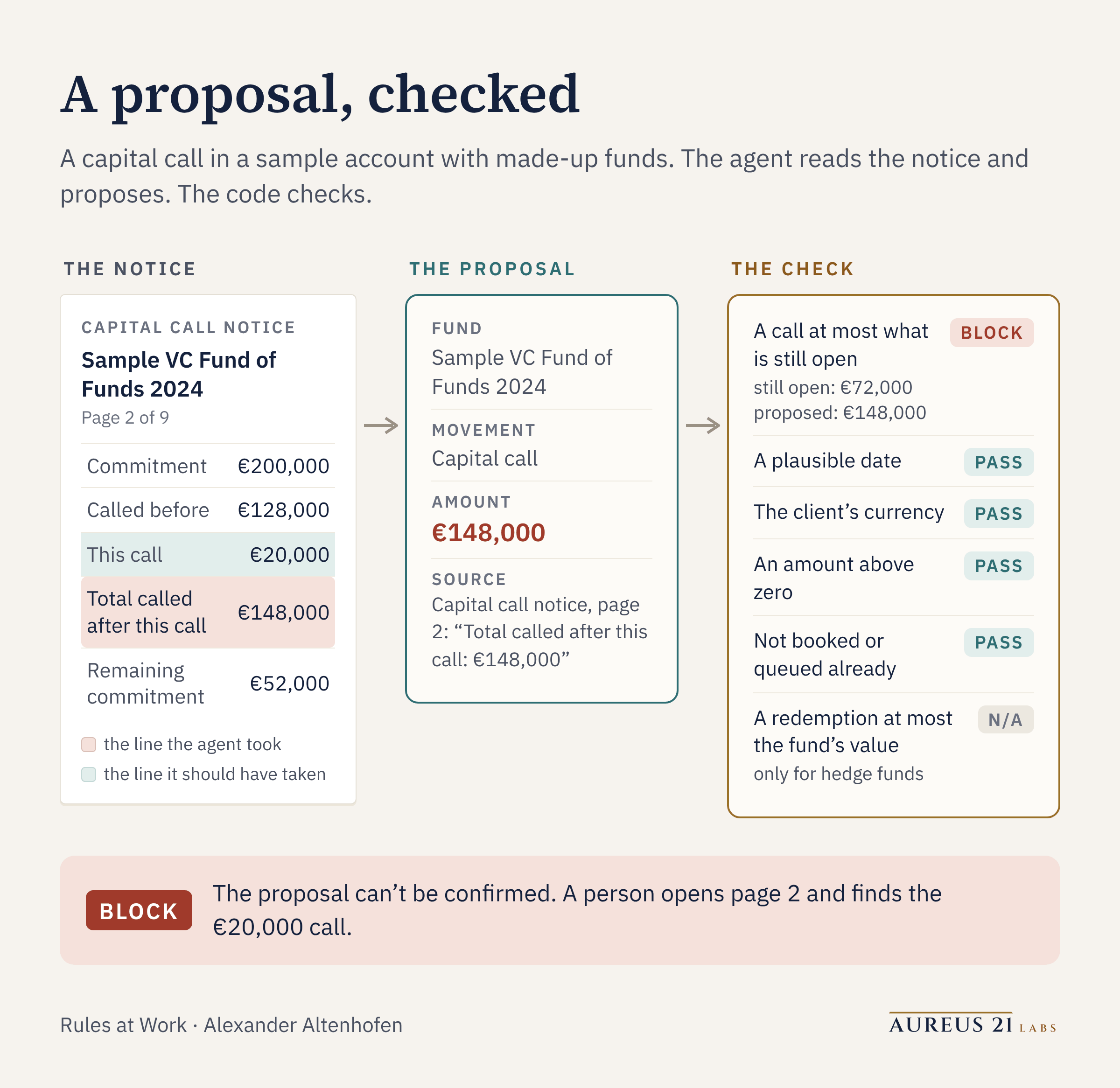
A booking proposal names the fund, the kind of movement (a capital call, a distribution, a subscription or a redemption), the date, the amount and the currency. And it names its source: the document, the page if there is one, and the exact passage the agent relied on.
The code then checks it, the same way every time:
- A capital call can’t be larger than what is still open on the commitment.
- The date has to be plausible. An impossible date blocks, an unusual one only warns.
- The currency has to be the client’s.
- The amount has to be above zero.
- The same movement can’t already be booked, or already be waiting in the queue.
- A redemption from a hedge fund shouldn’t be larger than the fund’s value. This one only warns, too.
Here is what that looks like in a sample account with made-up funds. A venture fund of funds has a commitment of €200,000, and €128,000 of it has been called, so €72,000 is still open. The new notice lists this call as €20,000, and the total called after it as €148,000. Suppose the agent takes the wrong line and proposes to book a call of €148,000.
BLOCK. The call is larger than what is still open.
Maybe the agent took the wrong line, as here. Maybe the fund made a mistake. The check doesn’t know which, and it doesn’t need to. It stops the number before it becomes a fact, and a person opens the page the agent quoted.
A person confirms
Every proposal lands in a queue, with the verdict and the quoted passage side by side. Only a person with the right to book can confirm it, never an agent.
Confirming checks again, because things may have changed since the agent proposed. Another call may have been booked in the meantime. A blocked proposal can’t be confirmed at all; it can only be rejected, with a reason. A confirmed booking takes exactly the same route as one typed in by hand, with a note saying which document and page it came from.
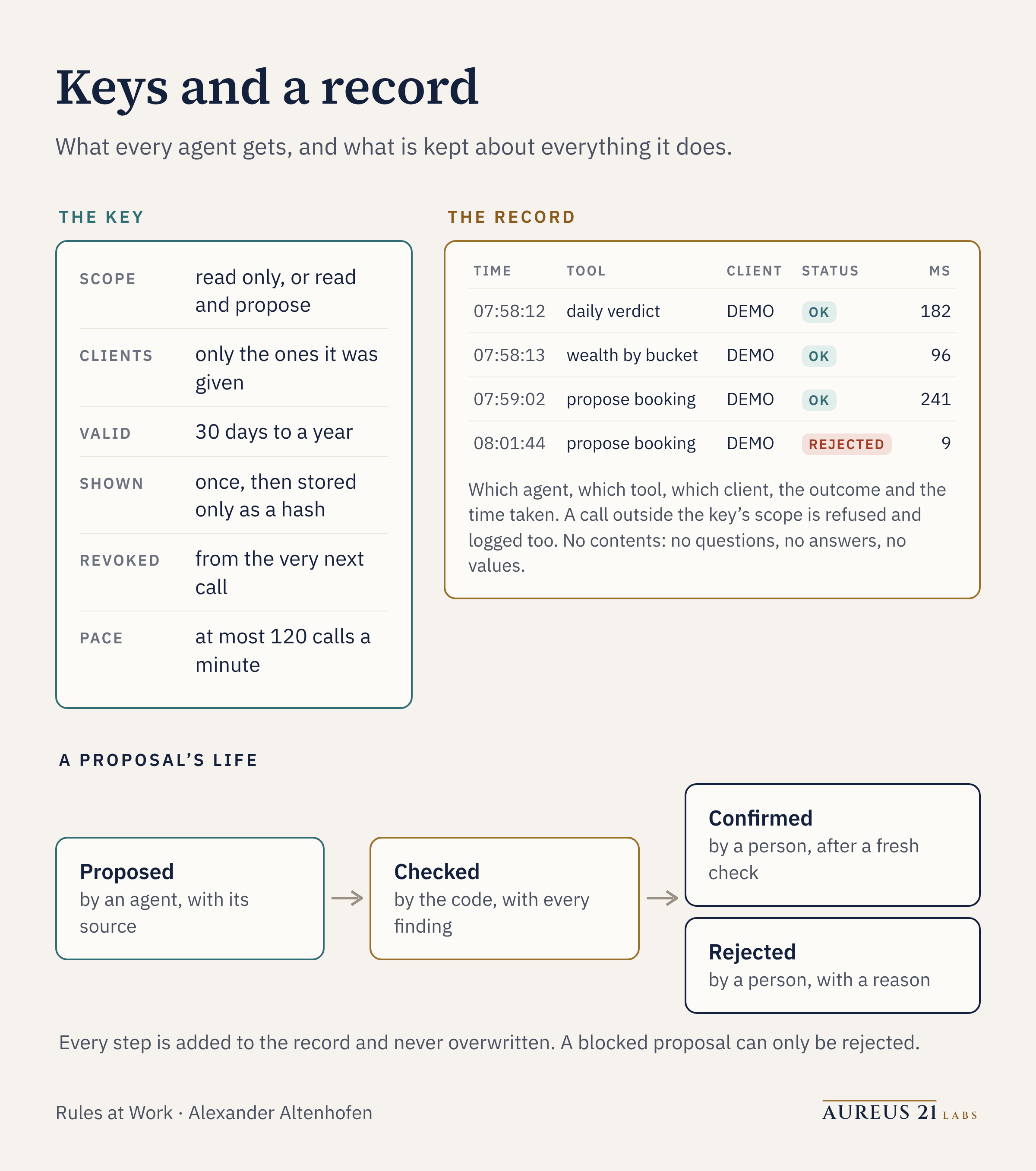
Every step is added to the record, never overwritten: proposed, checked, then confirmed or rejected. Six months later, I can still see what was proposed, on which evidence, and who said yes.
Keys, logs and an off switch
The last part is unglamorous, and it’s the part I’d look at first in any system that lets agents in.
- Every agent has its own key. It can read, or read and propose. It only sees the clients it was given, and it expires after 30 days to a year. The key is shown once and stored only as a hash.
- Every call is logged: which agent, which tool, which client, the outcome and the time it took. Not the contents.
- Every key can be revoked, and that takes effect on the very next call.
The point isn’t distrust. It’s that trust in an agent should come from a record, not from a demo. If an agent’s proposals pass the check and are confirmed unchanged month after month, that’s evidence. If they’re blocked every other week, that’s evidence too.
Why not let the agent do it all?
Models get better every few months. Some already read page two more reliably than I do on a Thursday evening. Why not let them book directly?
Because the controls shouldn’t depend on which model you use. Models change, and so do providers. The rules your books follow shouldn’t change with them. Put the checks in code, and the model becomes replaceable: a better one reads better, but it still proposes, and the same checks still apply.
And because an error with a good explanation is the most expensive kind. A tired person who mistypes a number usually produces something that looks wrong. An agent that takes the wrong line produces something that looks right.
Agents are good at reading, gathering and explaining. Checking and calculating belong in code. Deciding belongs to people.
Three questions for your setup
If you already let AI tools near your money, or your clients’ money:
- What can they change without you? Not what they’re told not to change: what they technically can.
- If an agent put a wrong number into your books, how would you find out, and when?
- Can you switch it off in one step?
Next week: the assistant that may not do maths, and why that makes it more useful, not less.
Alexander Altenhofen is the founder of Aureus 21 Labs and SVP Product & Tech at a large media company. He privately runs his family’s portfolios on a written rulebook with a team of AI agents. This post describes his own approach and is not investment advice.