
The Assistant That May Not Do Maths
An assistant that talks about your money should explain, not calculate. Every number it shows is checked against the record before anyone sees it.

It’s Sunday evening. You open your portfolio and see that the gold purchase you proposed on Friday was blocked. Next to the page is an assistant, so you ask it: why?
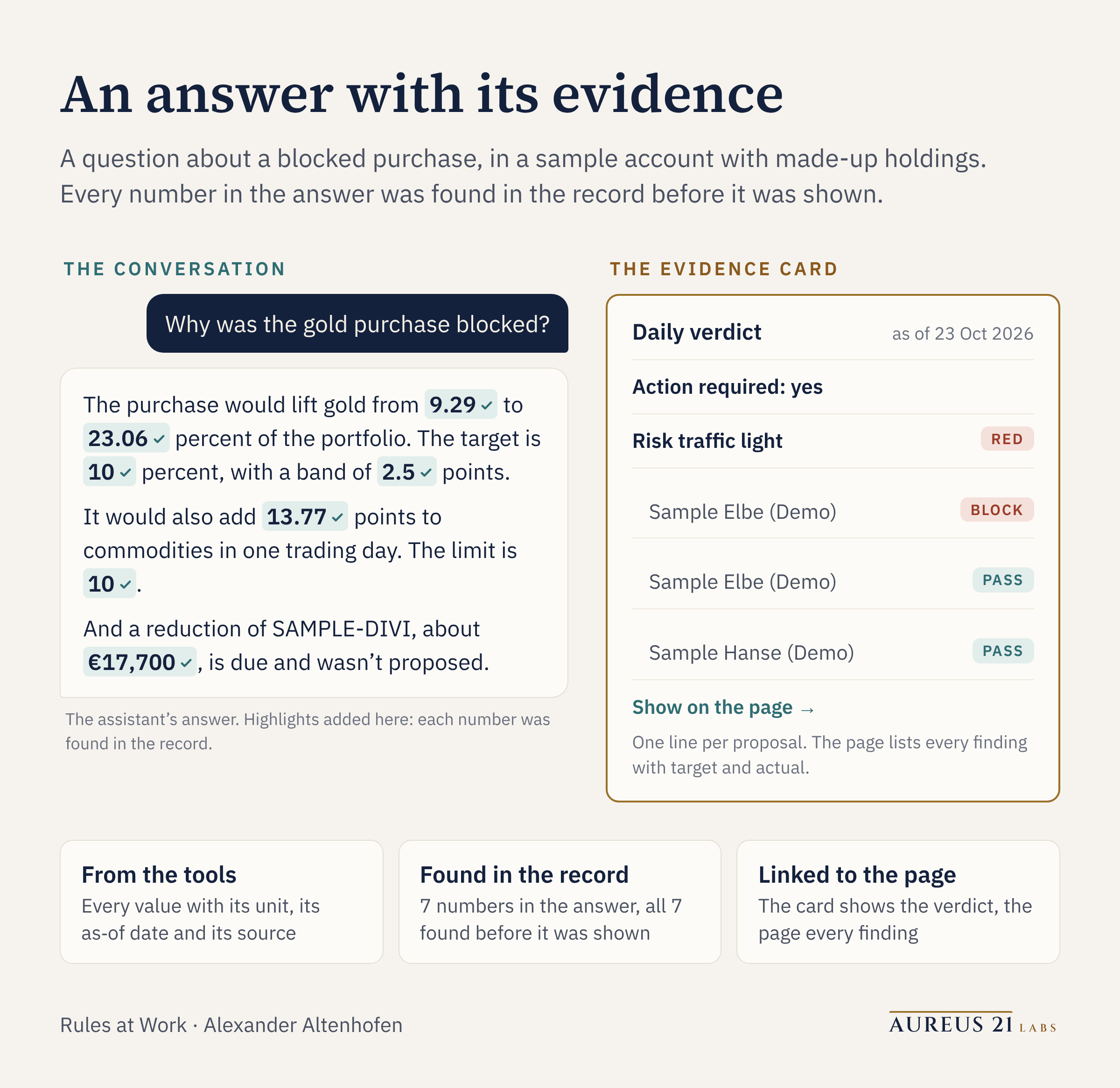
A few seconds later, the answer is there, in three short paragraphs. The purchase would have lifted gold from 9.29 to 23.06 percent of the portfolio, against a target of 10 percent. It would have added 13.77 points to commodities in a single trading day, where the limit is 10. And a reduction of about €17,700 in another fund is due and wasn’t proposed. Under the answer is a small card with the verdict, the date it is from, and a link to the page that lists every finding.
That’s the sample account from the demo, with made-up holdings. But the interesting part isn’t how fluent the answer is. It’s what happened before you saw it. Every number in it was checked against the record. And the assistant didn’t calculate a single one of them.
This is the second of three posts about rules at work. Last week was about agents that propose and code that checks. This week is about the assistant that explains the verdict, and why it may not do maths.
A chatbot is not a separate legal entity
In November 2022, after his grandmother died, Jake Moffatt asked Air Canada’s chatbot about bereavement fares. It told him he could book now and claim the reduced fare afterwards, “within 90 days of the date your ticket was issued.” The airline’s own page on bereavement travel said otherwise, and when he applied, Air Canada said no.
The case went to British Columbia’s Civil Resolution Tribunal. Air Canada’s position, in the tribunal’s words: “In effect, Air Canada suggests the chatbot is a separate legal entity that is responsible for its own actions.” The tribunal called that “a remarkable submission” and was blunt about it: “It should be obvious to Air Canada that it is responsible for all the information on its website. It makes no difference whether the information comes from a static page or a chatbot.” The airline had to pay the difference, 650.88 Canadian dollars, plus interest and fees.
The amount was small. The principle isn’t. Whatever an assistant tells a client, the firm said it. And in wealth management, a wrong number isn’t a typo. It’s a misstatement about someone’s money.
Why it may not do maths
Language models have become remarkably good with numbers. That isn’t the point. The point is that every number in an answer about someone’s money should have exactly one origin, and that origin should be the record.
So the rules for the assistant are strict. It reads with the same tools as the agents from last week: wealth, buckets, limits, verdicts, each value with its unit, its as-of date and its source. It may round a value to fewer digits. It may not add, subtract or work out a share. Not even a difference: ask how much room is left under a limit, and you get the limit and the current value, not the gap between them.
That sounds pedantic. It’s what makes the next step possible. If the assistant never calculates, every number in its answer has to appear somewhere in what the tools returned. And that, a machine can check.
Checked before anyone sees it
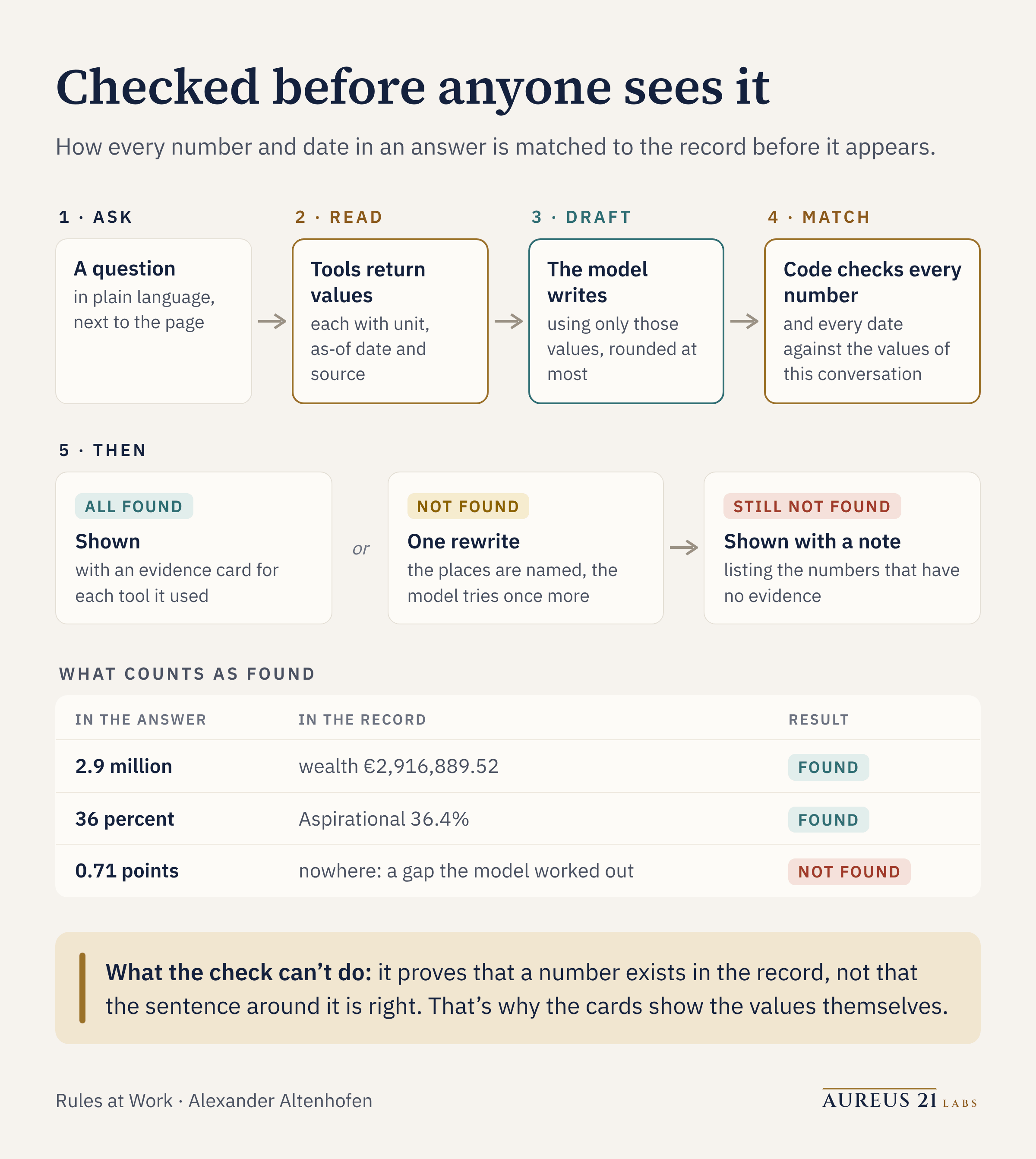
Before an answer is shown, the code reads every number and every date in it. It looks for each one among the values the tools returned in this conversation, the evidence from earlier answers, and the question itself. A number counts as found if one of those values, rounded to the precision written, gives exactly that number. In the sample account, “2.9 million” is found in a wealth of €2,916,889.52, and “36 percent” in a share of 36.4. A gap the assistant worked out by itself usually matches nothing, and is caught.
If something isn’t found, the assistant gets one chance to rewrite, with the places named. If a number still has no match after that, the answer is shown with a note underneath: these numbers have no evidence.
Under every answer are evidence cards for the data the assistant used, with the as-of date and a link to the page.
The check has a limit, and I’d rather be clear about it. It proves that a number exists in the record. It doesn’t prove that the sentence around it is right. An assistant could quote a true number in a wrong sentence: the right percentage, attached to the wrong fund. That’s why the answer comes with its evidence cards, and why every card links to the page where the numbers live.
The same check works for texts that leave the house. An agent drafting a client email or a quarterly letter can have it checked before it goes out. One number that doesn’t match, and the draft comes back with the places listed. Nothing is estimated, and nothing is quietly corrected.
Should I?
The most natural question to ask an assistant about money is the one it won’t answer the way you expect. Should I buy more gold? Should I sell this fund?
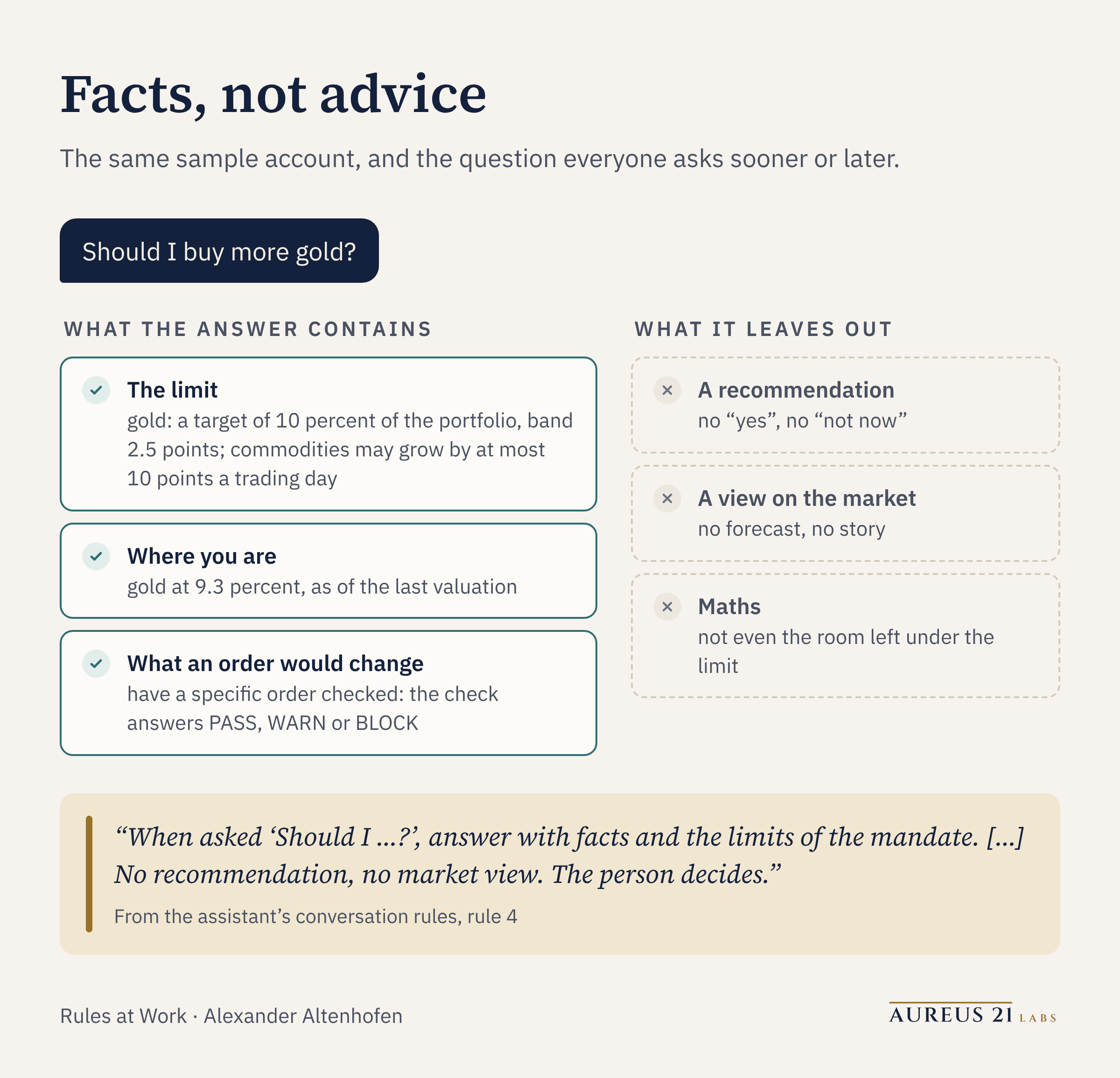
The assistant answers with facts and the limits of the mandate: the limit, where you are today, and what an order would change if you have it checked. Ask about more gold in the sample account, and you get this. Gold has a target of 10 percent of the portfolio, with a band of 2.5 points either side, and commodities may grow by at most 10 points in a single trading day. Today, gold is at 9.3 percent. If you want to know what a specific purchase would do, have it checked, and the check answers with PASS, WARN or BLOCK.
No recommendation, no view on the market, no maths. You decide.
Some people find that frustrating at first. I think it’s the point. The rules were written on a calm day. The assistant’s job on a hot one is to make them understood, not to replace them with an opinion.
Learning at the moment of decision
There’s a second reason I like this design, and it has to do with how people learn about money.
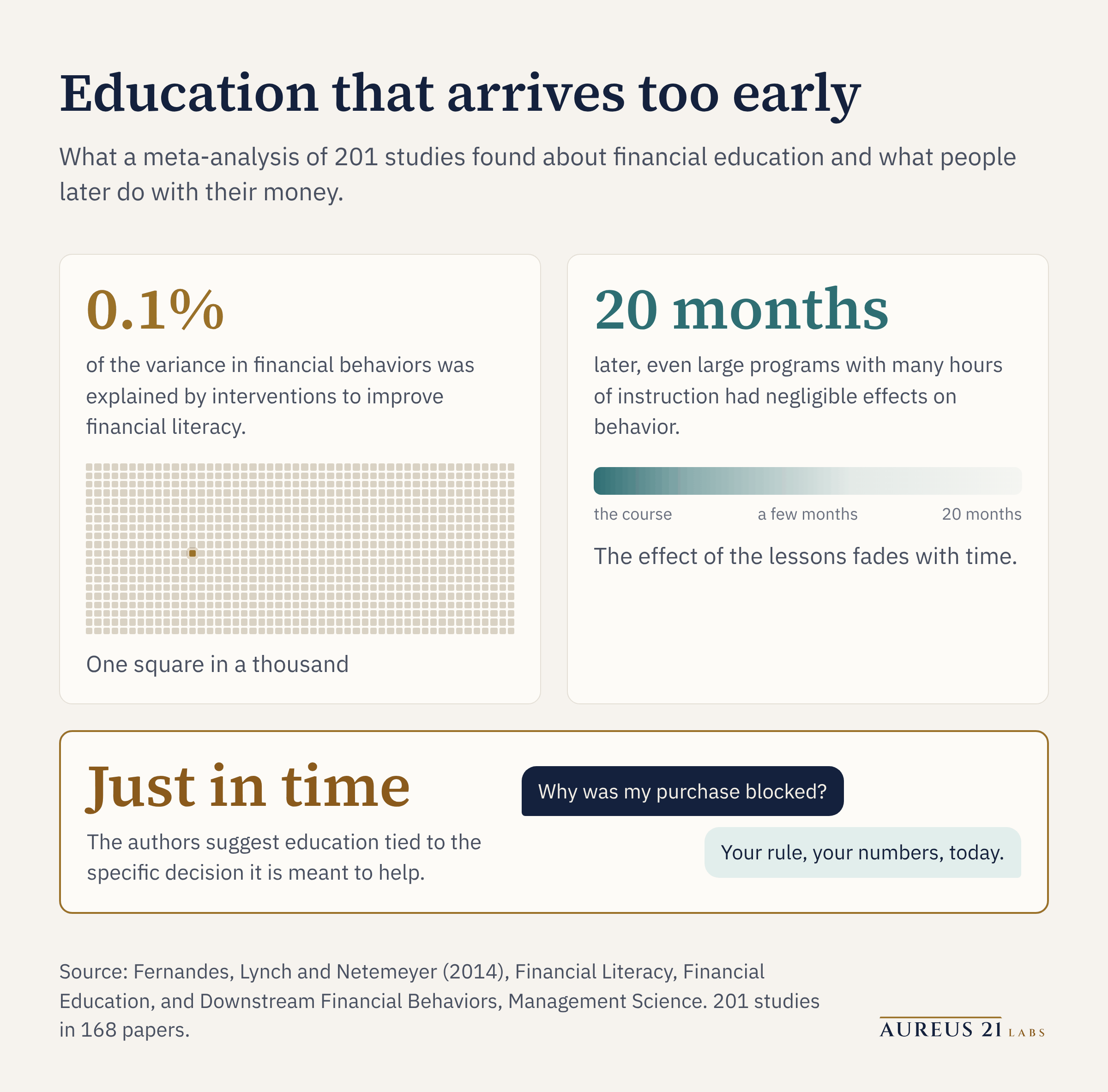
In 2014, Daniel Fernandes, John Lynch and Richard Netemeyer published a meta-analysis of 201 studies on financial literacy and financial education. The result was sobering. Interventions to improve financial literacy explained only 0.1 percent of the variance in the financial behaviors studied. Even large programs, with many hours of instruction, had negligible effects on behavior 20 months or more later. What the authors suggested instead was education “just in time,” tied to the specific decision it is meant to help.
An assistant that explains your own rule at the moment the rule says no is exactly that. Not a course on rebalancing, but an answer to “why was my purchase blocked?”, with your numbers, your rule and today’s date.
That matters most for the people who didn’t write the rules: a spouse, a parent, a client, and one day the next generation. They meet the rules at the moment the rules say no. That’s when an explanation sticks.
Three questions for your assistant
If you use an AI assistant with your money, or let your clients use one:
- When it tells you a number, can you see where the number came from?
- When it gets a number wrong, who notices, and is that before or after someone has read it?
- What does it say when you ask: should I sell?
Next week: three buckets, one balance sheet, and what changes when the rules see a family’s whole wealth, not just the brokerage account.
Alexander Altenhofen is the founder of Aureus 21 Labs and SVP Product & Tech at a large media company. He privately runs his family’s portfolios on a written rulebook with a team of AI agents. This post describes his own approach and is not investment advice.