
Emerging from the Shadows
My family office ran on a prototype built in Notion. Since November, it runs on Trebun: the rules are code, the agents work on top, and anyone can try it.

It’s 7:40 on a Tuesday morning. Regular readers know this minute. In the first post of this blog, it’s when a reduction that was due quietly didn’t happen.
This Tuesday is a real one, 3 November, and at 7:40 an AI agent checks my family’s portfolios against my rulebook, as it does every morning. It’s the agent with the veto.
It’s also its last run. Later that day, I switch it off, together with the two agents that plan my trades. By Wednesday, five of the eleven agents on my investment team are gone. None of them failed. Their work had moved into code.
For six posts, this blog has described a way of working: rules as code, agents on top, a person who decides. Until November, all of it ran on a prototype. This post is about leaving it.
A notebook that ran a family office
The prototype lived in Notion. My investment policy was a page, with a block of machine-readable constants next to the prose. The numbers came from a spreadsheet fed by my broker’s statements and a price feed. Sixteen agents, eleven of them on the investment team, each had a written mandate on a page of its own and ran as a scheduled task: the first at four in the morning, the briefing at eight, every day.
It worked, well enough to run my family’s money on it. It also showed me where a notebook ends:
- An agent can apply a rule, but it isn’t a calculator. A veto shouldn’t depend on one.
- A page can be edited. A record of verdicts shouldn’t be.
- The morning was a chain. When one run failed, the runs after it had nothing to work with, and a watcher restarted it once.
None of that is a flaw in the agents. It’s a question of what belongs where. In the product, the policy is versioned data: a draft, then a preview, then active. A daily run at six values every portfolio from the broker’s records and from prices the product fetches itself. Facts are only ever added. And the check that used to be an agent’s job is code, built to give the same verdict for the same inputs, with more than 3,000 automated tests behind it.
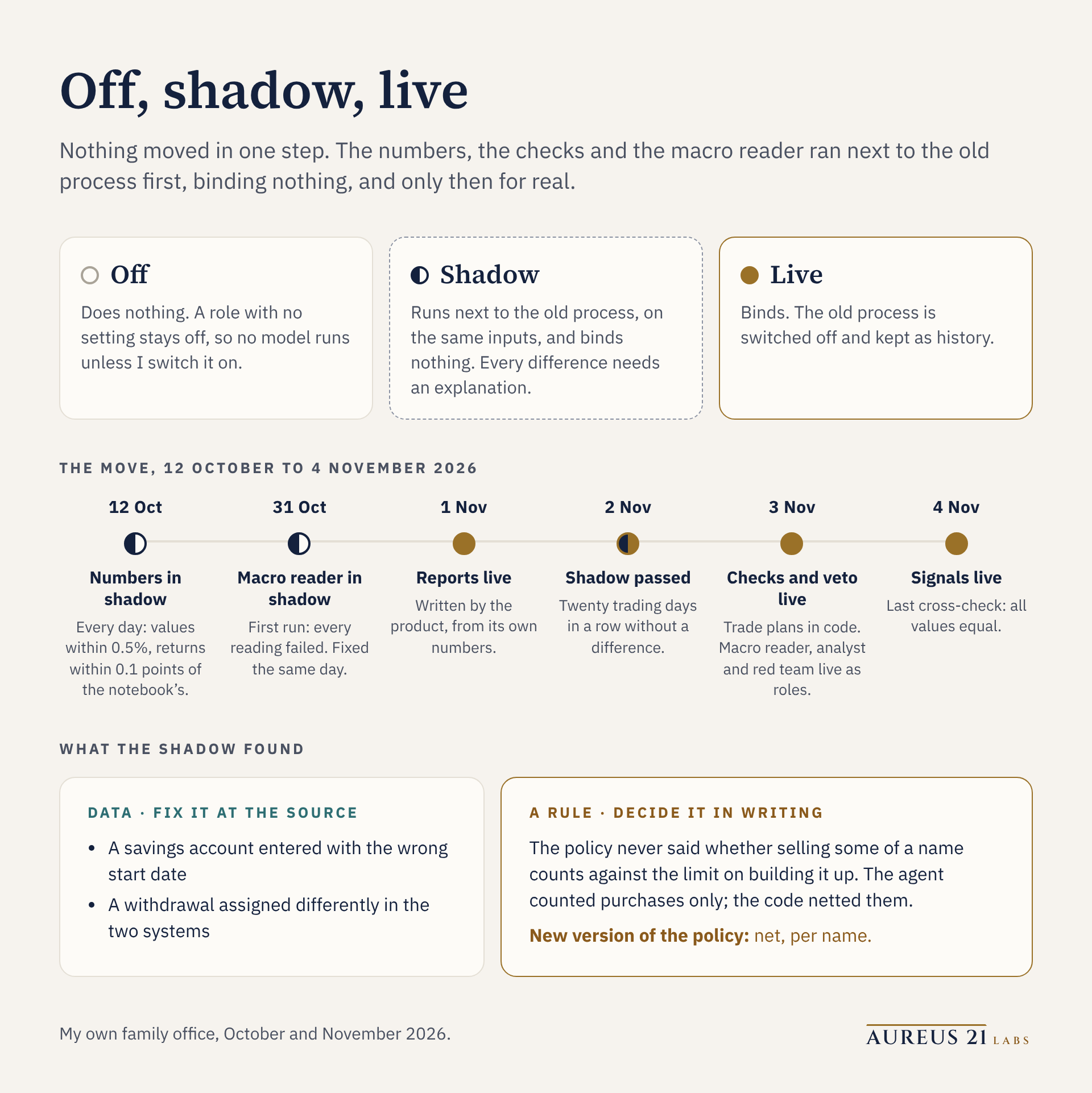
Off, shadow, live
Nothing moved in one step. There were three positions: off, shadow and live. In shadow, a new piece runs next to the old one on the same inputs and binds nothing. It goes live once every difference has an explanation.
The numbers went first. From 12 October, the product calculated my portfolios every day next to the notebook, and the two were compared with a tolerance of half a percent on values and a tenth of a point on returns. In the post on rules as code, I wrote that the agents’ verdict would count until the code had matched them for twenty trading days in a row. It got there on Monday, 2 November, the day before I switched. What the comparison found on the way was more interesting than the count.
Most differences were data. On day one, one of my two books matched to the cent, while the total was off by a whole savings account, entered with the wrong start date. Data you fix at the source.
One difference was a rule. My policy limits how fast a new position may be built up, but it never said whether selling some of the same name on the same day counts against that limit. The agent counted only the purchases. The code netted them. Neither was wrong: the policy was silent, and people and agents fill a silence without noticing. Code can’t. That one I didn’t fix. I decided it, in writing, as a new version of the policy.
That’s what a shadow run is for. Not to prove the new system right, but to find out where the old one was vague.
The macro reader moved the same way, with three days in shadow. Its first run failed completely; once fixed, it read the latest weekly report exactly as the notebook agent had. By 3 November, every difference had an explanation.
Where the agents went
Five agents no longer exist. Two planned my trades, one for the long-term portfolio and one for the smaller part that is allowed to swing. One computed the trend signals, one wrote the reports, and one checked every order: the one with the veto. Their work was calculating and checking, so it moved into code. By the time I read my briefing, every plan, signal and check of the day is computed and stored, and it can’t be edited.
Three became roles inside the product: the macro reader, an analyst who writes a memo for every new idea, and a red team that writes the case against it. They still use a language model, because reading and arguing are what models are good at. But the product decides what they get to see.
The macro reader shows how. A model reads the key pages of each research report twice, independently. If the readings disagree on anything that matters, a third reading decides by majority, and without a majority the value is marked as not available. Then code checks what was read before anything is stored: known terms only, totals that add up to 100 percent, every reference present.
The red team sees the memo and its sources, but not how the analyst got there. A new name can’t pass the purchase check without both. And a role with no setting is off, so no model runs unless I’ve switched it on.
Three agents still run in the notebook, on top: a scout that reads analysts and hands ideas to the analyst role, the controller, and the chief of staff who writes my briefing. The controller used to calculate. Now it copies the product’s numbers through the interface.
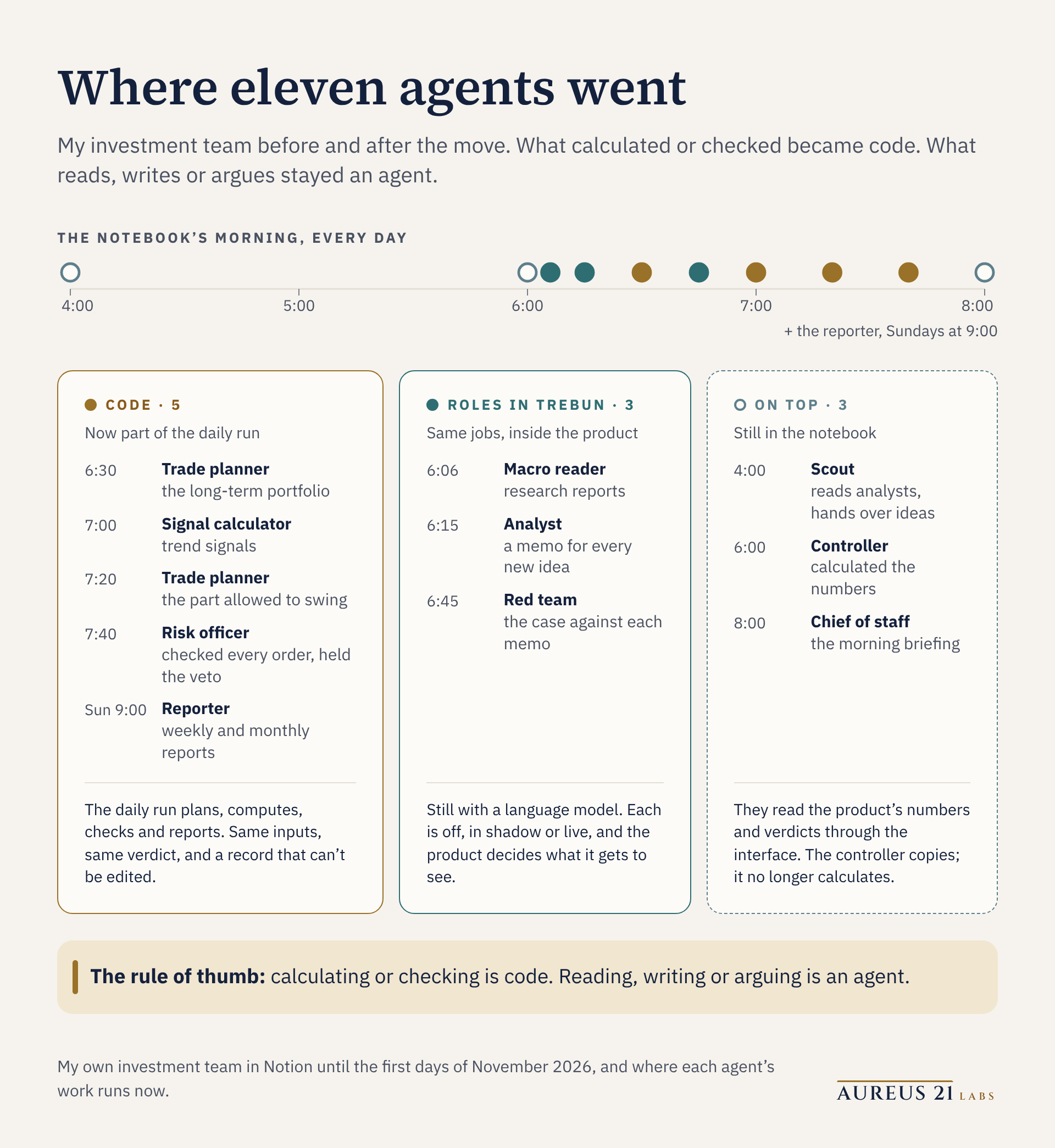
The rule of thumb is short. If a job is calculating or checking, it’s code. If it’s reading, writing or arguing, it’s an agent.
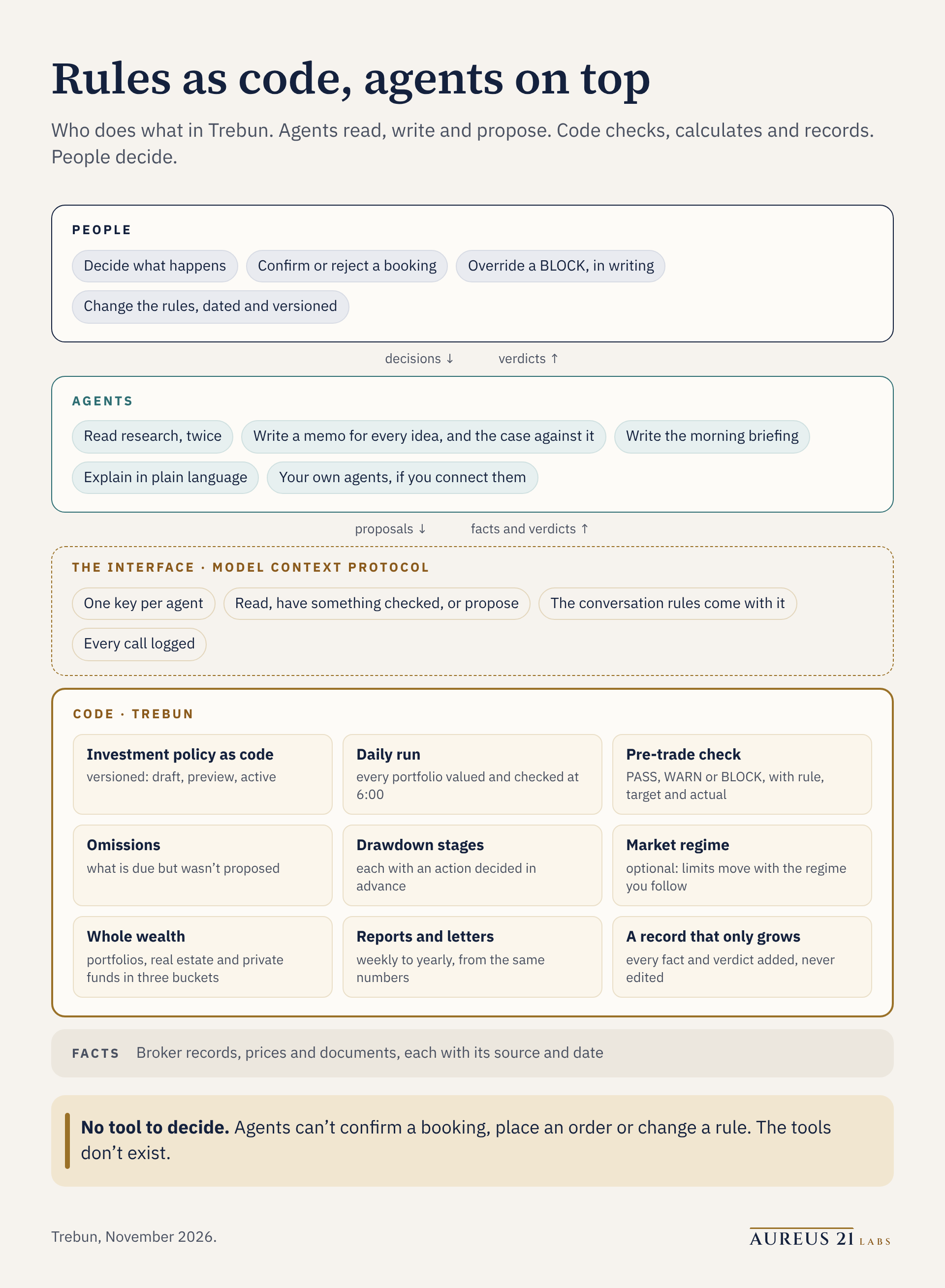
Rules as code, agents on top
The interface between the two is the Model Context Protocol, an open standard for giving AI agents tools. Its controls are the ones from the post on agents and checks: a key per agent, only its own clients, and no tool to confirm, execute or change a rule.
What’s new is that the rules of the conversation ship with the interface, versioned like an investment policy. Every number comes from a tool call, with its date and a link where a person can check it. No sums or shares of its own, and no estimates. Asked “should I…?”, an agent answers with the limit and where things stand, never with a recommendation. The agents that stayed used to read pages. Now they read tools.
The rules underneath can be as plain or as layered as the person who writes them. By default, the allocation is fixed, with a target and a band for each asset class. A mandate can also follow a market regime. Mine does: a macro framework from an independent research house tells me whether markets are in a risk-on or a risk-off phase, and the limit for each asset class moves with it. Trebun has no market view of its own. The regime comes from the research you choose, or from you, and the check applies it like any other rule.
What you can use now
The product is called Trebun, after the tribunes of ancient Rome. The office was created in 494 BC, and its defining power was a negative one: with a single word, veto, “I forbid”, a tribune could stop the act of a magistrate. But only in person. The tribune had to be there.
Trebun has the same job and the same condition. It can’t buy or sell anything, but it’s there for every order: you can have one checked before you place it, and the daily check looks at what actually happened, whether you asked or not. A blocked purchase needs a written override. Selling what you own is never blocked.
Since November, Trebun has been running my family office. And it’s open, two ways.
If you run your own money, the beta is open to everyone and free while it runs. Set your investment policy in six steps and import your holdings from your bank’s CSV file. From the next trading day, Trebun checks your portfolio against your rules every day. Your money stays at your bank. Trebun isn’t connected to it, places no orders and gives no advice.
Two more things come with the beta. A look-back runs your investment policy over the years since 2018, with public prices for each asset class, next to the same allocation rebalanced once a year and global equities alone. And if financial independence is the goal, a FIRE plan asks whether your wealth will last, even if markets fall right at the start. It sets your own assumptions next to what your allocation actually did since 2018, after German tax within the portfolio, and adds a stress test. Both calculate over the past. Neither says anything about the future.
If you look after other people’s money, as a family office, a wealth manager or a controller for families and foundations, the way in is the one I took: through the shadow. A pilot covers one mandate and liquid assets only. One week of setup, two weeks in shadow next to your current process, three weeks live. Then you decide. Your own agents can work on top through the same interface, with client data only under a data processing agreement and with a model hosted in the EU.

Three questions before you move your rules
If you’re thinking about putting your rules, or your clients’, into code:
- Which of your rules would a machine have to ask you about? Each of those questions is a silence you fill differently on different days.
- If a new process ran next to your current one for a month, where would they disagree, and would you know which one is right?
- Who in your setup calculates, and should they?
If you run your own money, try Trebun with your own portfolio. If you look after other people’s, write to me. A pilot starts in the shadow, the way mine did.
Next week: mild models, wild markets, the first of four posts about the books behind my rules.
Alexander Altenhofen is the founder of Aureus 21 Labs and SVP Product & Tech at a large media company. He privately runs his family’s portfolios on a written rulebook with a team of AI agents. This post describes his own approach and is not investment advice.