
The Last Mile of Discipline
Most investors know their rules. Very few can show that they followed them.

It’s 7:40 on a Tuesday morning, and one of your positions has been weak for weeks. The trend your framework watches has turned, and your rules are clear: cut it in half.
You don’t. It has already fallen, selling now would turn a paper loss into a real one, and it might bounce. You’ll look at it again next week.
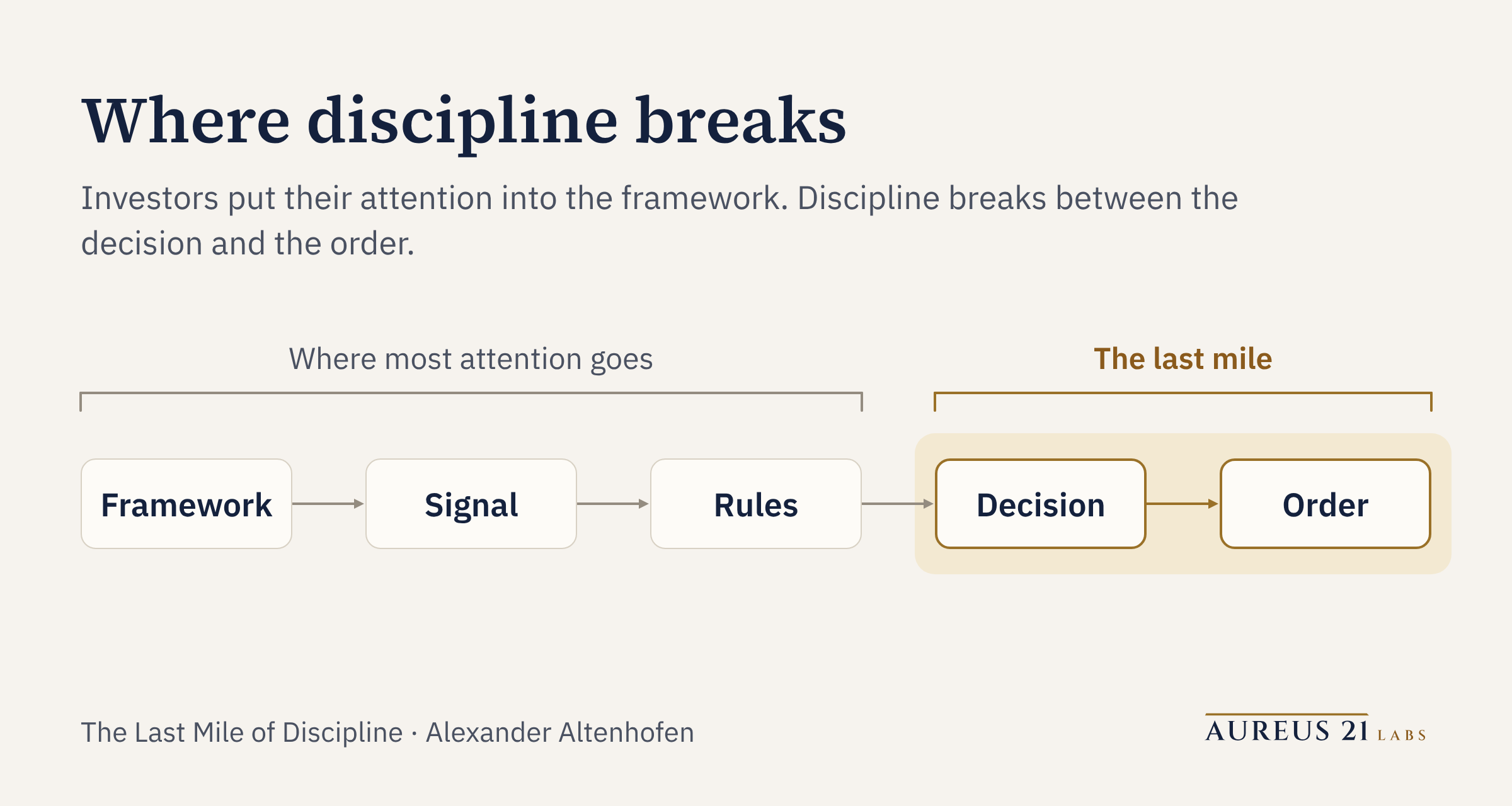
Nothing about that morning looks like a mistake. There’s no bad order, no confirmation slip, nothing to review later. And yet this is where most investment discipline fails: not in the framework, but in the last mile between knowing what to do and doing it.
This is the first of three posts about that last mile. It gets far less attention than choosing the right framework, and I’d argue it’s where most of the damage happens.
The framework is rarely the problem
I run a small family office: my own portfolio and a handful of family accounts, each under its own written mandate. The framework behind them is regime-based. It doesn’t try to predict markets. It adjusts how much risk I take to the economic backdrop and to the trend in each market, and it cuts risk at drawdown levels defined in advance.
But this post isn’t about my framework, and I’m not here to sell you one. Good frameworks are everywhere: a strategic 60/40 policy, a goals-based bucket approach, systematic trend following, regime models. Most of them work reasonably well, provided you actually follow them.
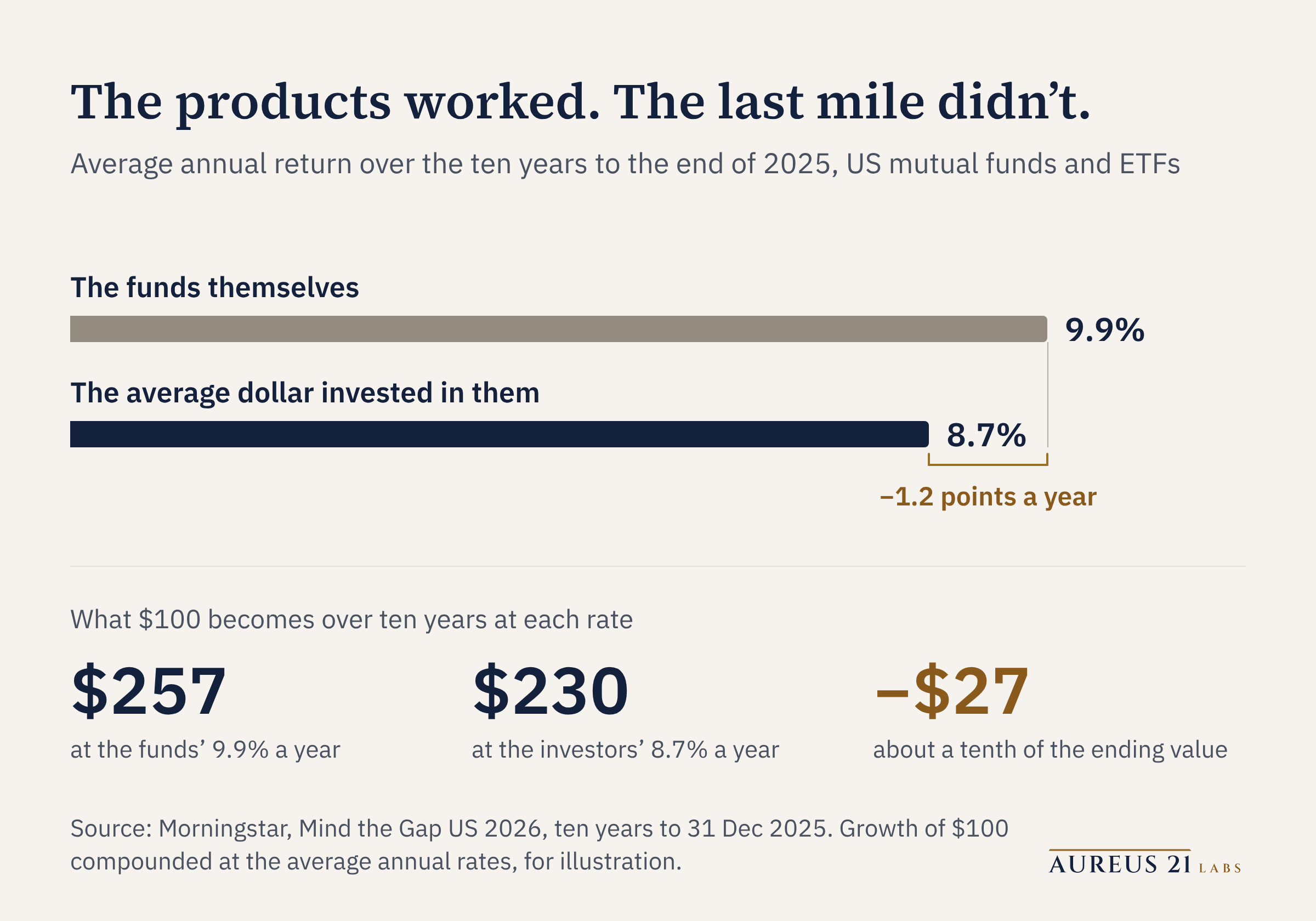
That proviso is expensive. Morningstar puts a number on it every year in its Mind the Gap study. In the 2026 edition, the average dollar invested in US mutual funds and ETFs earned 8.7% a year over the ten years to the end of 2025. The funds themselves returned 9.9%. The 1.2-point difference isn’t a fee, and it isn’t the fund managers’ fault. It comes from the timing of investors’ own purchases and sales. Compounded over ten years, it costs roughly a tenth of the ending value.
The products worked. The last mile didn’t.
Where discipline breaks
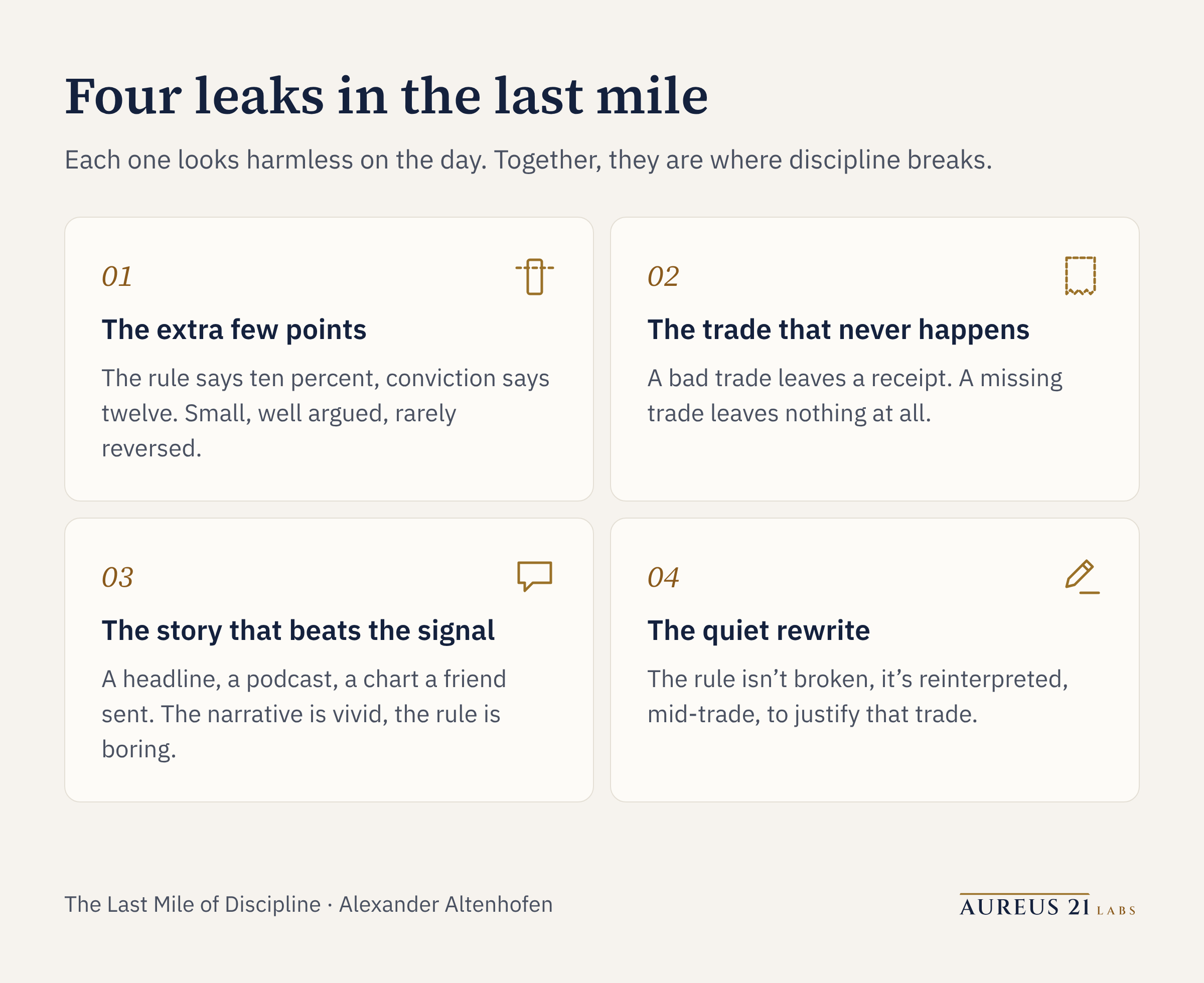
Watch any rules-based portfolio long enough and the same four leaks appear.
The extra few points. The rule says ten percent. Your conviction says twelve. It’s only two points, the setup looks great, and you’ll trim it later. Most rule breaks look like this: small, well argued, and rarely reversed.
The trade that never happens. Tuesday morning is the classic case. A reduction is due, or a purchase the rules call for feels terrible to make, and nothing happens. This is the hardest leak to see, because a bad trade leaves a receipt and a missing trade leaves nothing at all.
The story that beats the signal. A headline, a podcast, a chart a friend sent you. The narrative is vivid, the rule is boring, and the narrative wins. Daniel Kahneman put the mechanism into one sentence: “Nothing in life is as important as you think it is, while you are thinking about it.”
The quiet rewrite. Instead of breaking the rule, you reinterpret it. The limit was meant for normal markets. This position is really a core holding now. The exit level belonged to the old thesis. Changing your rules is legitimate; good investors refine them over time. Changing them in the middle of a trade, to justify that trade, is something else.
Why knowing better doesn’t help
None of this is a knowledge problem. Most people who make these mistakes could give you a decent lecture on loss aversion.
The problem is timing. We write our rules in a calm state, on a quiet weekend. We have to follow them in a hot one: after three red days, in the middle of a rally, with a headline on the screen. The behavioral economist George Loewenstein calls this the hot-cold empathy gap: when we’re calm, we underestimate how strongly emotions will drive our decisions later.
Loss aversion widens the gap. Kahneman and Tversky showed that losses weigh roughly twice as much as equivalent gains. And the more often we check, the more losses we see. Richard Thaler and Shlomo Benartzi called that combination myopic loss aversion. In a 1997 experiment by Thaler, Tversky, Kahneman and Alan Schwartz, the investors “who got the most frequent feedback (and thus the most information) took the least risk and earned the least money.”
Then there’s the scoreboard, or rather the lack of one. Philip Tetlock’s work on forecasting rests on an unglamorous discipline: write the forecast down precisely enough that it can be scored, then score it. Most investors keep score on returns. Almost nobody keeps score on whether they did what their own rules said. Without that record, every break feels like a one-off exception, and you never find out that it’s a pattern.
How I run it today
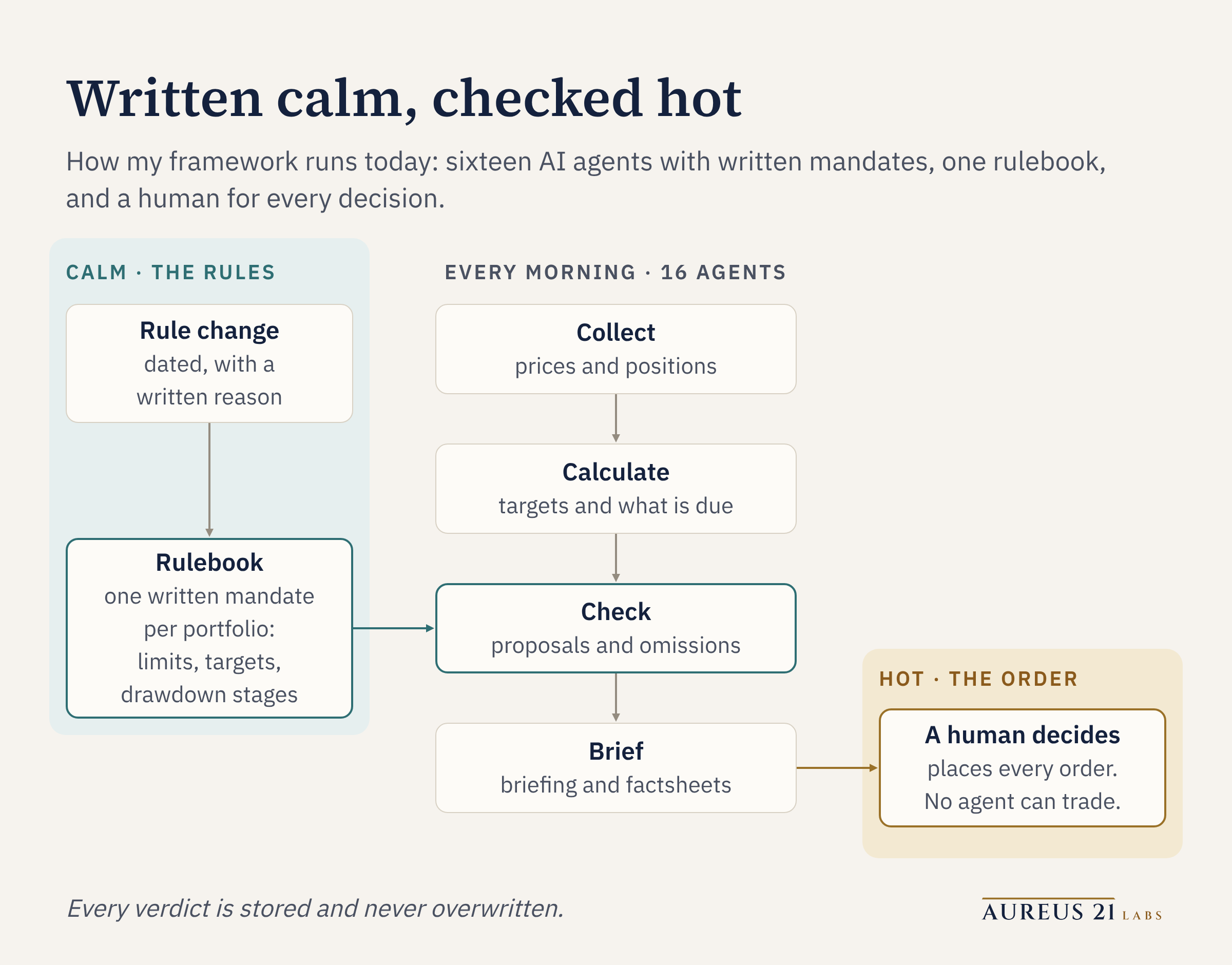
Since September, my framework runs with a team of sixteen AI agents. Each has a written mandate, like a job description: what it does, when, with which inputs, and what it is not allowed to do. Some collect prices and positions. Some calculate where each portfolio stands against its targets and what is due. One checks every proposal against the rulebook before it reaches me. Others write the morning briefing and the monthly factsheets. Every decision and every order stays with a human. No agent can trade.
The point was never to take judgment out of the process. It was to put judgment where it works. It works on a calm weekend, when rules are written. It’s unreliable on a Tuesday morning, when an order is placed. So the rules are written when it’s calm and checked when it’s hot, by something that doesn’t have Tuesday mornings.
That changes each of the four leaks:
- The extra few points are flagged before an order exists.
- The trade that never happens becomes visible. The check looks not only at what I propose, but also at what the rules say is due and nobody proposed.
- A story can still change my mind, but only through the front door: a dated rule change with a written reason, not an order placed in the moment.
- Every verdict is stored and never overwritten. The scoreboard keeps itself.
One principle in my rulebook sums it up: adherence before returns. Returns depend on markets. Adherence depends on me.
A test for this weekend
If you manage your own money, or other people’s, try three questions:
- Can you write down your rules from memory, including the limits?
- For your last ten trades, can you name the rule each one followed?
- What did your portfolio not do in the last three months that your rules said it should have?
Most investors can answer the first. Some can answer the second. Very few can answer the third, and that is the last mile.
Next week: why a written investment policy is a promise no one checks, and what your goals have to do with it.
Alexander Altenhofen is the founder of Aureus 21 Labs and SVP Product & Tech at a large media company. He privately runs his family’s portfolios on a written rulebook with a team of AI agents. This post describes his own approach and is not investment advice.