
Three Buckets, One Balance Sheet
Most family wealth doesn’t sit in the brokerage account. The rules should see the house, the private funds and the bills that are already known.

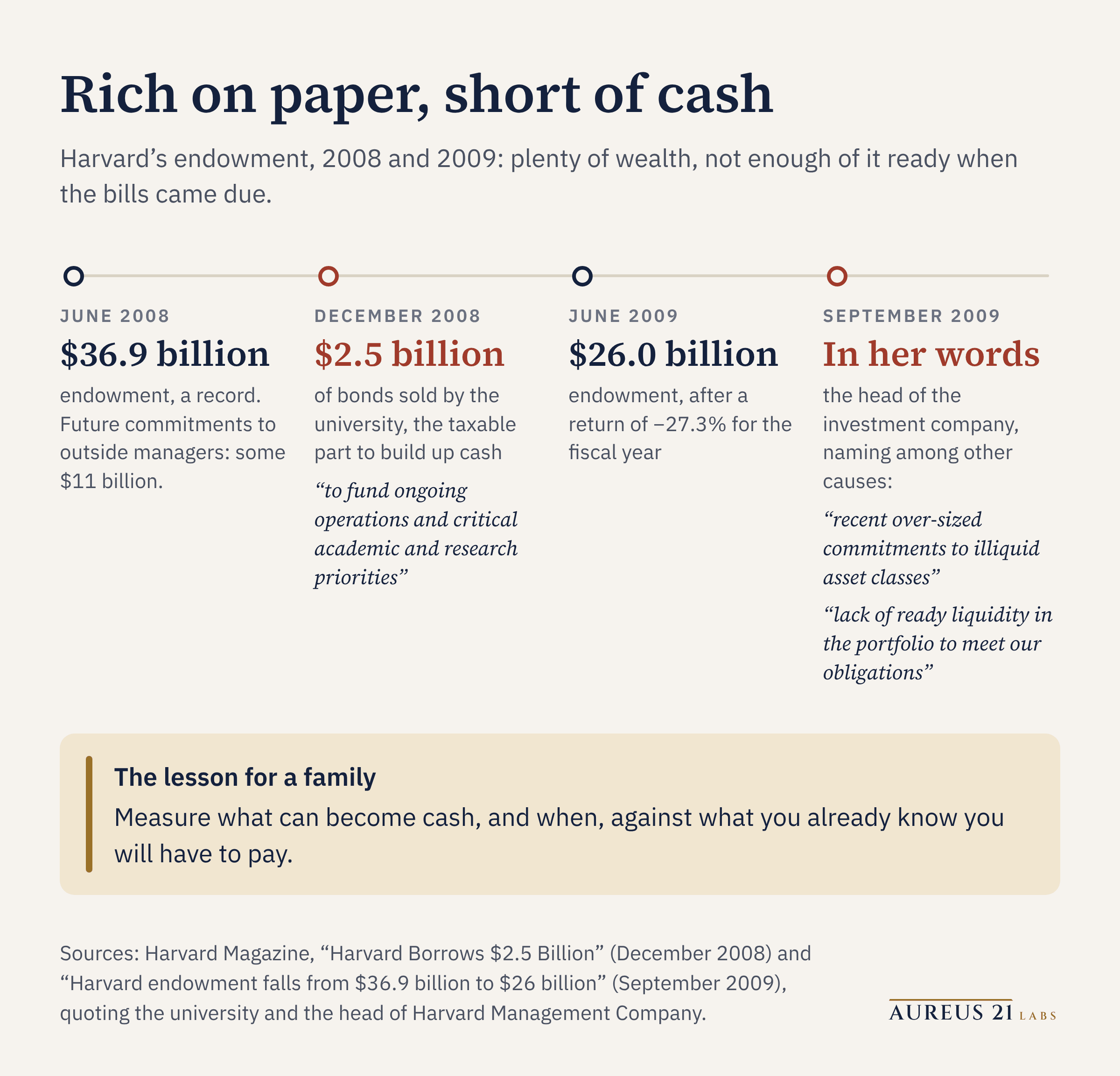
In June 2008, Harvard’s endowment stood at a record $36.9 billion. Six months later, the university was borrowing. In December it sold $2.5 billion of bonds. The larger, taxable part was to build up cash, in its own words “to fund ongoing operations and critical academic and research priorities.”
Harvard wasn’t poor. It had plenty of wealth. What it didn’t have was enough of it in a form that could pay the bills when they came due. At the end of June 2008, its investment company had future commitments to outside managers of some $11 billion. In September 2009, its head named, among other causes, “recent over-sized commitments to illiquid asset classes,” and a “lack of ready liquidity in the portfolio to meet our obligations along with the needs of the University.”
Families aren’t endowments. But many affluent families have built the same structure on a smaller scale: a house with a mortgage, maybe a rental flat or a holiday home, commitments to private equity funds that call money over years, a hedge fund with quarterly redemptions and three months’ notice. Each piece can make sense. Together, they can leave you rich on paper and short of cash.
This is the last of three posts about rules at work. Agents propose and code checks. The assistant explains, and may not do maths. This one is about what the rules can see: not just the brokerage account, but the whole balance sheet.
Most of the wealth isn’t in the portfolio
Rules for investing usually stop at the edge of the brokerage account. That’s where the prices are, where the orders go, and where a check is easy to build.
For many families, it’s also the smaller part of their wealth. The house is often the largest single asset. Then come the things that don’t trade every day: a rental property, a stake in private funds, a hedge fund, a business. And they come with obligations that don’t show up in any portfolio report: the mortgage payments, the capital calls still to come, the notice periods.
In an earlier post, I wrote about Ashvin Chhabra’s three buckets: Safety protects your standard of living, Market maintains it, Aspirational gives it a chance to improve. Those buckets only mean something if they cover everything. A Safety bucket that leaves out the house, or an Aspirational bucket that leaves out the private funds, is a promise about half the money.
Three buckets, one balance sheet
So the buckets now cover the whole balance sheet, and the assignment is fixed by type, not chosen each time:
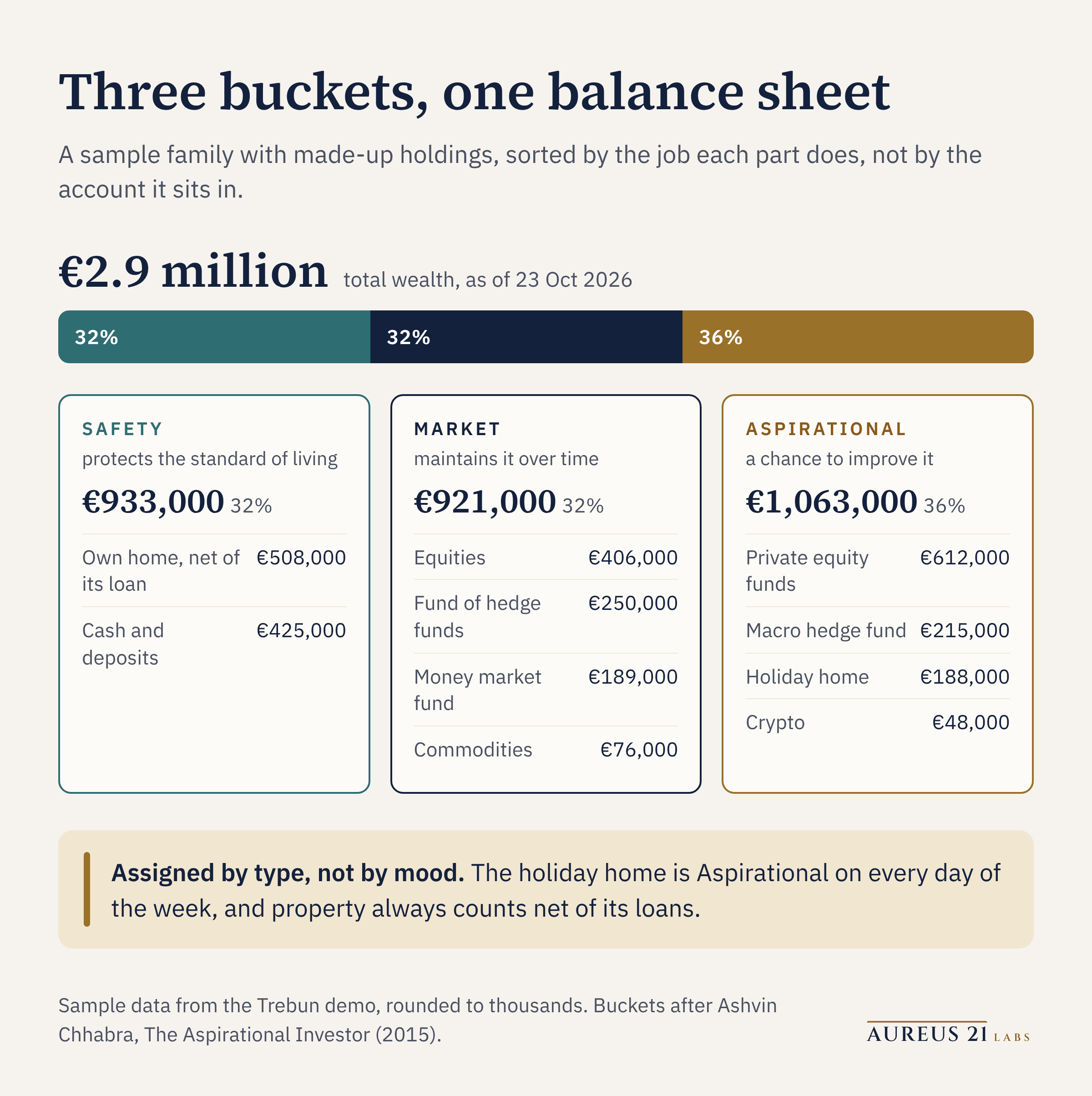
- Safety: cash and deposits, and your own home.
- Market: equities, bonds, commodities, money market funds, rented property, and diversified hedge funds.
- Aspirational: crypto, concentrated bets, private equity funds, the holiday home, and concentrated hedge funds.
Hedge funds are the one judgment call, made per fund when it’s entered: a fund of funds belongs in Market, a concentrated macro fund can go into Aspirational. A later change is possible, but it’s saved as a new version. Property always counts net of the loans against it. A loan without a property, say a credit line against the portfolio, stands as its own line and reduces the total.
Fixed sounds rigid. It’s meant to be. In that earlier post, I also described how buckets leak: in good markets, money drifts toward risk, one sensible-sounding step at a time. A bucket you can relabel is a bucket that leaks. If the holiday home could be called Safety whenever Aspirational looked too large, the buckets would mean nothing.
Here is what it looks like for a sample family with made-up holdings: €2.9 million in total, 32 percent in Safety, 32 percent in Market, 36 percent in Aspirational.
How fast it becomes cash
Buckets say what the money is for. They don’t say when you can have it. That takes a second view of the same balance sheet, sorted by how quickly each part becomes money:
- Available daily: accounts, money market funds, listed securities.
- Within a quarter: hedge funds with monthly or quarterly redemptions and no lock-up running.
- Months to years: property, and hedge funds with longer redemption cycles or a running lock-up.
- Locked until maturity: private equity funds.
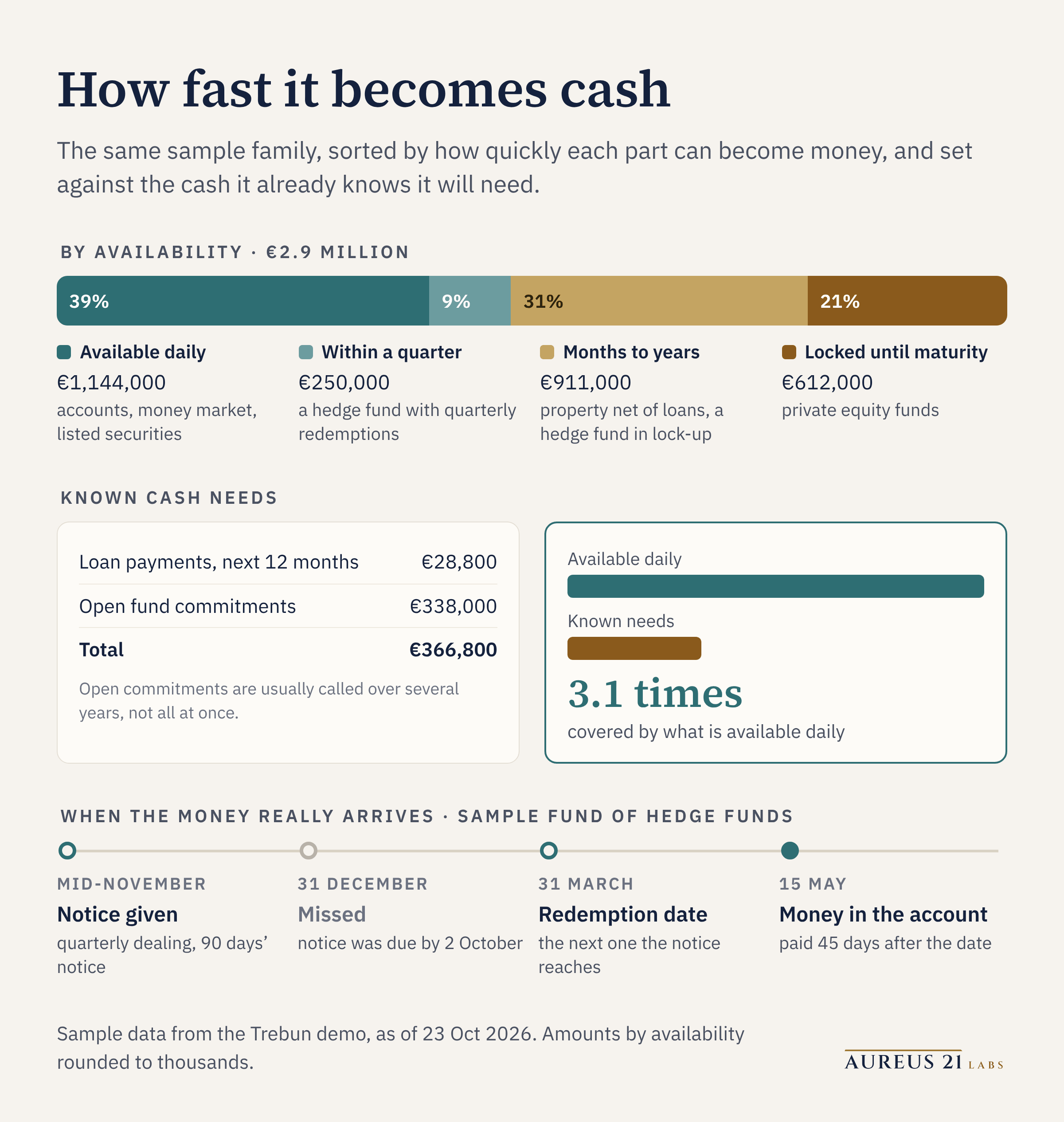
For the sample family: 39 percent is available daily, 9 percent within a quarter, 31 percent takes months to years, and 21 percent is locked until the funds end.
A tier only means something against what you will need. Two needs are known in advance: the loan payments over the next twelve months, from the repayment schedule, and what is still open on fund commitments. For the sample family, that’s €28,800 in loan payments and €338,000 in open commitments, €366,800 in total. What is available daily covers it 3.1 times. If it covered less than once, the line would turn amber and show how much is covered. And because open commitments are rarely called all at once, the page says so too.
Then there is the date the money actually arrives, which is rarely the date you’d guess. Take the sample fund of hedge funds: quarterly redemptions, 90 days’ notice, paid 45 days after the redemption date. Give notice in mid-November, and you’ve already missed the December date; that notice was due by 2 October. The next date is 31 March, and the money arrives on 15 May. Six months, for the part of the balance sheet that is “within a quarter.”
That’s the comparison Harvard’s investment company named in 2009: obligations on one side, ready liquidity on the other. For a family, it fits on one page.
Objectives, compared with today
That earlier post ended with three questions. One of them: does your policy still say what each part of the money is for, and does the portfolio still match? For the whole balance sheet, that question turns into a few numbers you write down once and review every year. A target return. The largest fall you could live with in a severe year. The largest share that isn’t available daily. The largest share in the Aspirational bucket. And in words: what the money is ultimately for, what you prefer, and what you never want to own.
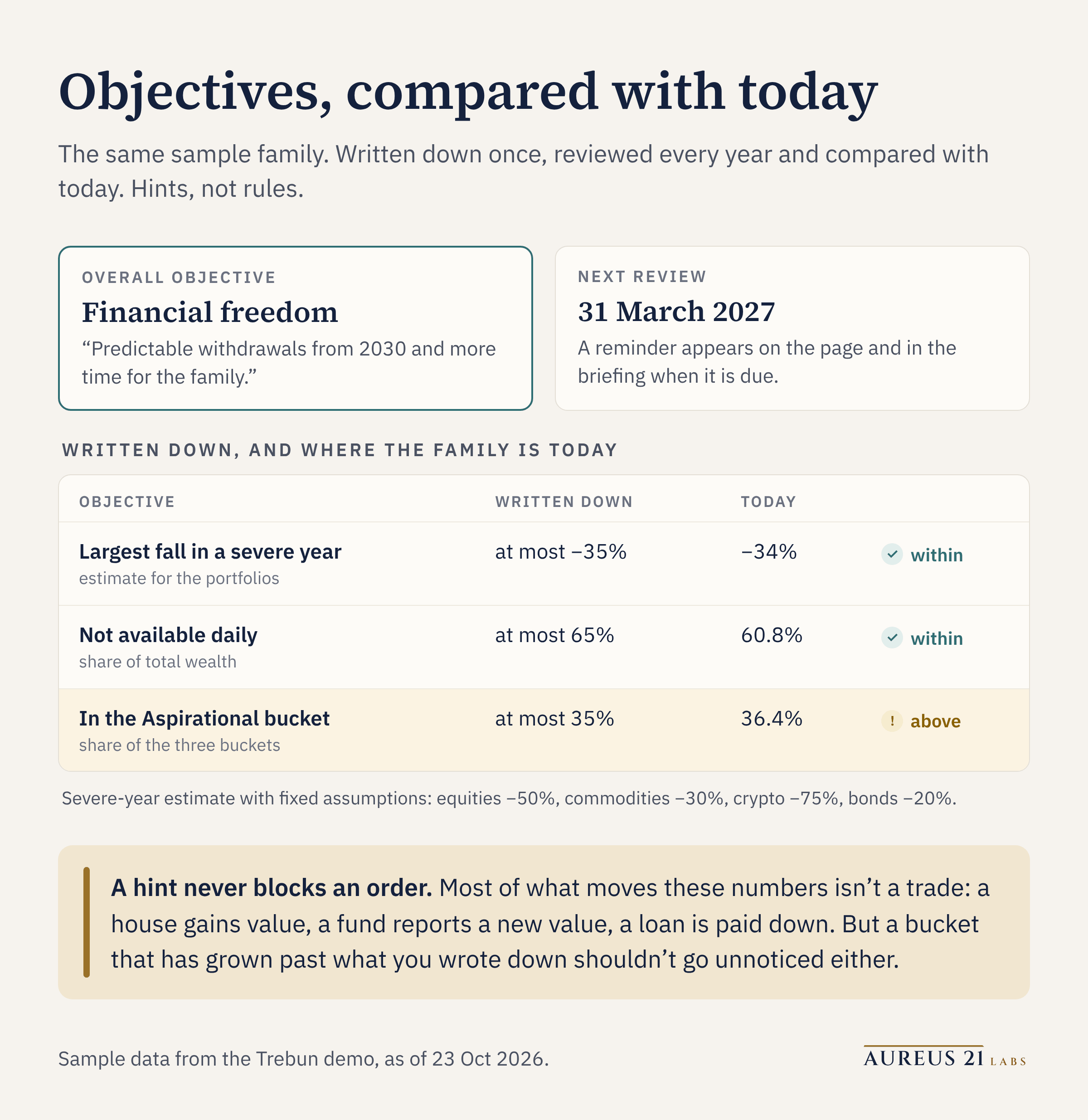
Then the page compares them with today. The sample family wrote down financial freedom, with “predictable withdrawals from 2030 and more time for the family.” A fall of at most 35 percent in a severe year: today’s estimate for the portfolios is 34 percent, within. At most 65 percent not available daily: today 60.8 percent, within. At most 35 percent in Aspirational: today 36.4 percent, above.
That last line is a hint, not a block. The comparison never stops an order, and that is deliberate. Most of what moves these numbers isn’t a trade at all. A house gains value. A private fund reports a new value. A loan is paid down. Blocking a purchase of a world equity fund because the lake house went up in value would be absurd. But a bucket that has grown past what you wrote down shouldn’t go unnoticed either. So it is marked on the page, right next to what you wrote down. And once a year, the review date puts the objectives themselves back on the table: until you’ve reviewed them, a reminder sits on the page and in the briefing.
One calculation
There’s one more rule behind all of this, and it ties the three posts together: nothing is calculated twice. The page, the wealth report, the answers the agents get and the evidence cards under the assistant’s answers all come from the same functions. When an agent reads the buckets, it reads what you see. When the assistant quotes the coverage, it quotes the number on the page. There is one balance sheet, and everyone, people and machines, reads the same one.
Three questions for your balance sheet
- How much of your wealth could you turn into cash within a quarter, and on which date would it actually arrive?
- What will you have to pay over the next twelve months, and how much is still open on your fund commitments?
- Which bucket has grown past what you once wrote down, and did anyone notice?
Three posts, one idea
Agents propose. Code checks and calculates. People decide. And the rules see the whole balance sheet, not just the part that trades every day.
If you run your own rules, for yourself or for clients, and you’d like to see them at work like this, try Trebun with your own portfolio or write to me.
Alexander Altenhofen is the founder of Aureus 21 Labs and SVP Product & Tech at a large media company. He privately runs his family’s portfolios on a written rulebook with a team of AI agents. This post describes his own approach and is not investment advice.